








Home
Category Listing
Monthly Archive
Baseball Reference
Red Sox Links
About

Recent Posts
Recent Comments
Essential Empy
Meta
  • Atom 1.0RSS 2.0Feedburner
  • Enter your e-mail address below for updates powered by Feedburner
  • Visitors to EE since November 2004
  • A Red Sox Top 10 Source
    Top 10 Sources
  • Boston Phoenix Best of ’06
    Phoenix Best
  • Blog contents, images, and design
    © 2004-2008 by Joanna J.M. Hicks.
    All Rights Reserved.
    Copyrights and trademarks for the books, films, articles, and other materials are held by their respective owners and their use is allowed under the fair use clause of the Copyright Law.

Home » Monthly Archive » April 2006

April 30, 2006

Resurface

Game 24: April 29, 2006
Red Sox (14-10), 9
Devil Rays (10-14), 6
W: Keith Foulke (2-1)
S: Jonathan Papelbon (10)
BS: Travis Harper (2)
BS, L: Tyler Walker (3, 0-2)

Last night it was the Devil Rays’ turn to fail to capitalize on offensive opportunities. Tampa Bay had a chance to salt the game away early in the first. Lenny DiNardo allowed three straight singles and images of last week’s meeting against the Blue Jays, who vaulted to an early 4-0 lead, descended from the catwalks of Tropicana Field.

Ty Wigginton, the roving fielder with the league-leading RBI total, ground into a double play to score Joey Gathright. Given all possible outcomes, it was one of the more favorable. The Devil Rays scored in each of the next two innings, including Greg Norton’s first home run of the season. In fact, it was Norton’s first homer since 2004. Jonny Gomes, whom we are more accustomed to seeing go yard, did so in the third with Carl Crawford on the bases. Crawford had reached because DiNardo hit him with a curveball. Due to the intense rivalry between the teams, home plate umpire Mike Winters saw fit to issue warnings to the dugouts. Because of a DiNardo curveball. Just wait until Scott Kazmir and Curt Schilling lock horns this afternoon.

Revivified by the umpire’s injustice, the Red Sox got around to making their statement in the sixth inning. Manny Ramirez homered, Trot Nixon doubled, and Jason Varitek walked, a collection of events that finally chased Doug Waechter from the game.

Relief pitcher Travis Harper promptly gave up a single to Mike Lowell to load the bases. Wily Mo Peña lined a single to left field to bring his team within two runs of the Devil Rays. Kevin Youkilis tied the game with a clutch two-out, two-run double to the opposite field.

Julian Tavarez replaced DiNardo in the sixth inning with the expectation of shutting down the uppity Tampa Bay lineup. Those expectations were short-lived as Toby Hall propelled the second pitch he saw for his second homer of the season.

With the Devil Rays once again in the lead, the Red Sox had to unveil their hidden weapons in the seventh. Ramirez unleashed his speed on the basepaths for his 16th career triple. Ramirez haters may think he was tarrying before first base, but I give the left fielder the benefit of the doubt that he thought his ball was hit foul at first. Ramirez isn’t used to discerning fair versus foul territory deep along the foul lines because of hitting for so long in Fenway. Furthermore, he also didn’t execute his usual bat drop and home run demeanor at contact. At any rate, Ramirez was plated by Nixon, who displayed his not-often-seen ability to hit to opposite field for a sacrifice fly to tie the game.

But Gomes has dangerous devices of his own, and responded with a leadoff double in the eighth inning. Wigginton moved him over with a sacrifice fly and Gomes would tally another run on Hall’s fly ball to shallow left. Ramirez very nearly hosed Gomes, but the ball got hung up in the runner’s cleats.

Terry Francona deftly handled the top of the ninth inning. Youkilis led off with a line drive single to left and was pulled for pinch runner Willie Harris. With a speedy utilityman on first, Francona knew that he had half the equation for a hit and run play, so he pinch hit Mark Loretta, who is a better contact hitter than Alex Cora, who started in the two-spot.

But Tyler Walker did as his surname states; he walked Loretta and David Ortiz to load the bases. Walker was able to strike out Ramirez but gave a free pass to Nixon to permit the tying run. The Boston hit parade marched three more runs across the plate (including an RBI single for Peña that was lined off a Dan Miceli breaking ball), which was more than enough for Jonathan Papelbon to work with.

Papelbon sustained his remarkable rookie relief run. With just fourteen pitches he rang up the side. He now owns the all-time record for rookies with ten saves in April. He is tied with Murray Wall for most saves by a Red Sox rookie. Wall, whose nickname was “Tex,” was 30 years old in 1958 when he set the record. Wall’s career ended the next year, apparently because of injury. No such misfortune seems to be in store for Papelbon, who can pitch no matter how catastrophic his hairstyle is.
April 29, 2006

Submerge

Game 23: April 28, 2006
Red Sox (13-10), 2
Devil Rays (10-13), 5
L: Matt Clement (2-2)
W: Casey Fossum (1-1)
H: Dan Miceli (2)
S: Tyler Walker (1)

If I were to tell you that the opposing team’s pitching staff would yield nine walks in the course of a game and is 28th in the majors for team ERA (5.63 cumulative), 26th in strikeouts (123 total), and second in walks (101 season to date), you would probably think the Red Sox would walk all over said team.

Instead, Boston’s bats proved impotent against an incompetent group of hurlers. The Red Sox lineup had just six hits. Seventeen at bats came and went with runners in scoring position, and only twice, both in the eighth inning, did Boston batters come through with hits.

Red Sox fans may have already voiced their near-hysteric concern over Wily Mo Peña’s fielding, but at least he’s no Jonny Gomes. The sometime Devil Ray outfielder somehow lost track of Jason Varitek’s fly ball in the second inning, which resulted in the captain’s ninth career triple. The subsequent trio of Mike Lowell, Trot Nixon, and Peña could not bring a run home.

To lead off the fourth inning, Casey Fossum hit both David Ortiz and Manny Ramirez. Both were clearly unintentional. But still, imagine if Josh Beckett or Curt Schilling had been on the mound? Next Varitek and Lowell both flied out, but Nixon walked to load the bases. Peña nearly snuck a grounder up the middle, but it was intercepted by the jack-of-all-trades Ty Wigginton, who stepped on the second base for the force. In another sign of the impending heat death of the universe, thanks to the two RBIs he notched in the first inning, Wigginton leads the AL in RBIs with 24.

Another indication of increasing entropy was Matt Clement beating Carl Crawford in the sixth inning foot race to first for the final out of the inning.

The Red Sox squandered another bases loaded opportunity in the seventh inning. Alex Gonzalez and Kevin Youkilis reached on back-to-back bases on balls. With two on and no out, Mark Loretta struck out and Ortiz advanced the runners with his ground out to second base. With first base open, however, Ramirez was given nothing to work with, leaving the task to score runs to Varitek. Varitek has had only one grand slam in the majors; two, if you count his bases-loaded clout in the World Baseball Classic. The Red Sox catcher enjoyed an eight-pitch at bat but came up empty, popping out to second base.

Vague signs of life in the form of back-to-back doubles by Lowell and Nixon in the eighth at least assured the Red Sox would not be shut out. J.T. Snow pinch hit for Gonzalez and knocked a single up the middle to plate Nixon.

The score should have been 6-2. Home plate umpire Bruce Froemming missed a call that would have granted Gomes a run in the fifth inning. With Gomes and Wigginton on second and first with no out, Toby Hall bunted. Clement did not reach the ball in time, but Lowell did. Lowell’s throw took an odd hop and Youkilis could not catch it on the first bounce, but did recover in time to “hose” Gomes at home. Replays showed Gomes actually did touch home before the tag.

No number of gifts from the umpire could have salvaged last night’s debacle. The Red Sox now must win the second game of the series or they will have dropped three consecutive series.

April 28, 2006

Dave’s Diegesis: Colophony Conspectus

All religions, arts, and sciences are branches of the same tree.
Albert Einstein

Baseball is like a religion to me, one that combines ineffable artistry and infallible science in a single medium. My days as a ballplayer were some of the best times of my life and those memories will never leave me. The reminiscences are still so vibrant to me: I can recall the smell of the freshly-shorn field and hot dogs, the sound of the ball smacking into the catcher’s mitt and the gruff voices of vendors, the brilliant white of the foul lines receding into cheerful yellow of the foul poles. And the feelings: the cinch of the belt around my waist, my cap snug around my temple, and the reassuring heft of the rosin bag in my palm.

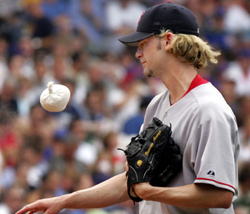
The rosin bag is one of the few foreign objects permitted to remain on the field during play. You’ll see it perched on the back of the mound, perpetually within the reach of hurlers. Pitchers like me use it to enhance their grip on the ball. The powder provides the proper balance of dryness and tackiness that is essential for the pitcher to feel comfortable with his release. Every pitcher has his or her idea of the ideal combination of slickness and friction; the amount of rosin assists in calibrating the touch.

RosinbagarroyoLike so many of the implements of baseball, rosin has its origins in the pine tree. In fact, rosin does carry the distinctive tang of conifers. Just as maple syrup is tapped, resin from pine trees is collected. Resins from different types of trees are collected, and each manufacturer has its own secret combinations.
The sap is then distilled into turpentine, the volatile solvent, and rosin. Rosin is processed differently for its varied uses. For luthiers, rosin is mixed with beeswax and particles of precious metals to alter the tone of their musical instruments. Baseball rosin bags have humbler companions such as cornstarch or talc.

Another name for rosin is “colophon,” from the Ionian city of the same name which was once known as the primarily as the exporter of the substance. The meaning of colophon evolved to be associated with printing and books, probably because of the use of rosin as a fixative for inks. The word now refers to the back matter of publications which describes the typeface and any other production details of a book but also is the name for any publishing house’s trademark. RoSIN, an abbreviation of RetroSheet Intraplay Notation, is a subset of the language created to power RetroSheet and is attempting to be the standard syntax for describing baseball plays electronically.

Words and baseball, like the interplay between pitcher and catcher--always passing meanings and ideas between each other, semaphorically and metaphorically.

Every Friday, Dave McCarty will join us to discuss a topic of interest to him and probably no one else but the author of this site.

Massacre

Game 22: April 27, 2006
Red Sox (13-9), 3
Indians (12-10), 15
L: Josh Beckett (3-1)
W: Paul Byrd (3-2)

The Cleveland Indians should be number three on the ThreatDown, just below the Blue Jays and bears. They are still a young team, as witnessed by Grady Sizemore’s tagging up in the seventh inning with the score 13-3. He’s lucky it was the final game of this series, or his ribcage would likely be graced with the imprint of baseball stitches.

For the Red Sox, it was a night of firsts, some good, some bad. Wily Mo Peña made his first start as a center fielder in a Red Sox uniform and recorded no errors in two attempts, both fly balls off the bat of Ronnie Belliard. Josh Beckett gave up the first grand slam of his career to Ben Broussard in the first inning.

Boston was feeble at the dish, scraping together only eight hits and going 2-10 with runners in scoring postion. Predictably, David Ortiz had those two hits, although he struck out to end the game with runners on second and third.

Alex Cora had two uncharacteristic throwing errors in the second and seventh innings, both resulting in runs scored. When your defensive whiz shortstop can’t field cleanly, a loss seems inevitable.

At least Manny Delcarmen is racking up major league innings but not without taking some lumps in the process; his two-thirds of an inning pitched in the seventh ended with a line of four hits, four runs (two earned), walk, and strikeout. Impressively, the whiff was earned against Travis Hafner.

If you’re tired of the tired old arms the Red Sox have been trotting out in late innings, there is change in the wind. Craig Hansen was promoted to Triple-A Pawtucket yesterday.

April 27, 2006

Drab

Game 21: April 26, 2006
Red Sox (13-8), 1
Indians (11-10), 7
L: Tim Wakefield (1-4)
W: Cliff Lee (2-1)

Each game I carefully select a single word to recap the game. Can you guess why I chose this particular word?

So there. Are you pro-Arroyo guys happy now? Wily Mo Peña now has as many home runs as Bronson. Last night Peña jolted a homer in the fourth inning for Boston’s only run of the game.

Just kidding. I miss Arroyo, too. Who would have known he was so well-suited to Great American Ballpark and the National League? He is currently sporting a 4-0 record with an orderly 2.34 ERA. However, I do think that once the NL hitters have seen more of him, the more vulnerable he will become. I wonder if he has booked a gig at Bogarts yet?

Although scorn is being heaped upon backup catcher Josh Bard, please do note that, despite the four passed balls, he broke up Cliff Lee’s no-hitter in the top of the third inning. Lee has only given up three gopher balls this season and all of them have been to right-handed hitters.

Travis Hafner may have a candy bar tastily named “Pronk” after the “part project, part donkey” tagline he adopted during his push for the MVP last season, but he certainly runs slowly. In the third inning, he grounded out to Kevin Youkilis. Youkilis fumbled multiple times with the ball but still managed to relay it in time for Tim Wakefield to tag the bag. Perhaps Hafner should consider developing an energy bar.

I think Jason Davis really wants to be on the Red Sox. How else would you explain that facial hair? Davis pitched two scoreless innings, allowed no hits, and walked a single batter. I’d prefer him over a few of the current bullpen options.

Manny Delcarmen made his first appearance this season, fresh from being recalled. The righty pitched the ninth and gave up four hits and two earned runs with no walks or strikeouts.

Wakefield has had similar losing streaks in the past; it appears worse than it is because of the new catcher and everyone has exceedingly high expectations at the beginning of the season. Also, in comparison to Curt Schilling and Josh Beckett’s outstanding streaks, Wakefield’s 1-4 April is frightful. Just as easily, however, the knuckleballer can win four or five in a row.

April 26, 2006

Antinomy

Game 20: April 25, 2006
Red Sox (13-7), 8
Indians (10-10), 6
W: Keith Foulke (1-1)
H: Mike Timlin (6)
S: Jonathan Papelbon (9)
H: Jason Davis (1)
BS: Scott Sauerbeck (1)
L: Guillermo Mota (0-1)

Last night was both sublimely divine and delightfully silly. Which other team but the Red Sox could come from behind twice in late innings and yet butcher plays on the basepaths with such aplomb?

Early in the game Mark Loretta proved that he hits when it matters. With the bases loaded and two out in the top of the second, the Red Sox second baseman swatted in two RBIs with his gutshot single.

Two runs are not enough against a team like the Indians, who have compiled the following team stats in comparison with all other major league teams:

  • Third for batting average at .308.
  • On-base percentage of .365, also placing them third.
  • “Just” fifth in slugging with .478.
  • Ranked third in RBIs 114.
  • A bit weak in walks, placing 17th with 65. (The Red Sox are second with 95. Surprisingly, the Cincinnati Reds lead the majors with 103.)

Ben Broussard is not the likeliest of the high-powered Cleveland lineup to tie the score, but he arced a two-run homer in the bottom of the second to knot the game at 2-2.

Apparently, Manny Ramirez was confused in the third inning. After lining a single to the opposite field to lead off the inning, the sometimes addled left fielder seemed to lose track of the number of outs. He left second base early with the count against Mike Lowell at 3-2. Ramirez found himself in limbo between second and third as pitcher Jake Westbrook noticed the wandering baserunner. Catching Westbrook’s relay toss, Aaron Boone forced Ramirez to retreat towards second as Jason Varitek tried to advance to the same base. Boone flung the ball to the jaunty Ronnie Belliard and the Red Sox captain was out. Belliard then passed to Victor Martinez, who tagged Ramirez was attempting to take third to salvage his gaucherie. Just your typical 1-5-4-2 double play.

There was another run-of-the-mill 6-2-3-6 double play by Cleveland in the seventh inning. Willie Harris was at the dish with Lowell at first and Varitek at third. Harris grounded to Jhonny Peralta, who knew that the play at first would be close with the alacritous Harris zooming down the base line. The Cleveland shortstop opted to throw home to nab Varitek.

Those sorts of baserunning blunders fall by the wayside when one thinks of the David Ortiz game-tying leadoff roundtripper in the seventh inning. Scott Sauerbeck, who thankfully made only one appearance in the 2003 ALCS for the Red Sox, threw one and only one pitch that evening. Ramirez also came through in the eighth inning with his two-out, three-run roundtripper that would grant Boston the lead they would not relinquish.

The bullpen had some key strikeouts. After walking Peralta, Keith Foulke got Travis Hafner to whiff at a change-up in the seventh to end the inning. Foulke is showing that he’s gamely trying to get his job back as closer. With runners on first and second and two out, Grady Sizemore missed Mike Timlin’s appetizing sinker in the eighth and quashed the chance for a rally. By the time the ninth inning came about, the Indians batters were pressing and over-anxious; Jonathan Papelbon sat them down in succession with just 10 pitches.

April 24, 2006

Scavenge

Game 19: April 23, 2006
Red Sox (12-7), 6
Blue Jays (9-8), 3
W: Matt Clement (2-1)
H: Keith Foulke (2)
H: Mike Timlin (5)
S: Jonathan Papelbon (8)
L: Josh Towers (0-4)

Josh Towers has yet to win a game this season. In the four games he has started he has given up at least four earned runs; in his two-inning effort against the White Sox on April 16th he had five earned runs. Suffice to say, Towers is not an elite American League pitcher.

But if the option is to fall in a series sweep, you take any advantage you can. A first inning score like the two-run homer David Ortiz provided helps. So does Mike Lowell piercing the infield defense to drive in Manny Ramirez, who reached on a broken bat grounder up the middle. Ramirez was so looking forward to getting into the dugout to hug Ortiz or eat applesauce he didn’t slide into home but dashed right on top of it.

In the top of the third, Kevin Youkilis turned his first 3-6-3 double play. Frank Catalanotto, in a departure from his usual role of Red Sox killer, grounded sharply to Youkilis. The converted first baseman threw the ball to Alex Gonzalez so that it led him up and away from the sliding Russ Adams. Youkilis then returned to the bag in perfect position to field the final toss for the final out of the inning. And to think I had my doubts about Youkilis transitioning to first.

There were quite a few quirky things about this game:

  • In the fourth inning, Lowell threw erratically, missing his target Youkilis. For a Gold Glover like Lowell, it should have been a routine ground out to third and throw to first to seat Vernon Wells. After inducing a fly out from Troy Glaus, Clement walked Lyle Overbay to give Gregg Zaun the chance to take over Catalanotto’s function. Of course Zaun took full advantage by jacking a three-run roundtripper into the stands of center field. It was Zaun’s second homer of season; not bad for a guy who has only made six starts.
  • With one out and third baseman Glaus positioned deep, Jason Varitek attempted to bunt for a base hit in the fifth inning. He advance the runners but also tallied the second out. Lowell was intentionally walked to load the bases and Willie Harris grounded out to end the potential rally.
  • Zaun doesn’t fully relish his stint as Red Sox gadfly. With the bases loaded in the fifth, the backup catcher flied out to deep right field, just in front of the luminescent scoreboard walls of Rogers Centre.
  • Ortiz bunted for a single in the sixth inning in response to the overshift. The bases would eventually be clogged with Red Sox runners, but Trot Nixon missed his chance for a grand slam after grounding Scott Schoeneweis’s pitch Overbay.
  • Keith Foulke pitched a perfect one and two-thirds innings and struck out Adams, Wells, and Glaus in the process.
  • Gonzalez finagled a walk out of Vinnie Chulk to lead off the eight. The second baseman and Youkilis combined for a hit and run. Perched at third, Gonzalez scored easily on Mark Loretta’s liner to center.
  • The Red Sox scored in the ninth on a Lowell double, which isn’t so unusual. What is odd in this inning is that Harris walked on four pitches and Youkilis struck out.
  • Jonathan Papelbon allowed singles to Adams and Catalanotto to commence the ninth. He bore down to strike out Vernon Wells on six pitches and then induced Glaus to ground into a 6-4-3 double play.

Tomorrow Boston has its first series against the powerhouse Cleveland Indians. The probable pitchers, Jake Westbrook, Cliff Lee, and Paul Byrd, have combined for a 5-5 record, but we all know that win/loss records for pitchers can be deceiving. Cleveland is 10-9 and boasts the one of the more fierce lineups in the majors.

April 23, 2006

Shorn

Game 18: April 22, 2006
Red Sox (11-7), 1
Blue Jays (9-7), 8

L: Lenny DiNardo (0-1)
W: Roy Halladay (2-1)
S: Pete Walker (1)

For the second time this season the Red Sox drop a series, and both times it has been to the Blue Jays.

Aside from the unveiling of Jonathan Papelbon’s mohawk, the only interesting moment in the entire broadcast was the profile of the Red Sox’s new second baseman. NESN showed a photograph of Mark Loretta at the University of Hawai‘i. He must have went to the islands for a “road” trip series against Hawai‘i while he was at Northwestern. I searched through Northwestern’s baseball archives, but their website only has data from 1997 onward.

Odd things happen with Trot Nixon on the bases. Last year, he was hit by a batted ball and was called out. Yesterday in the top of the second inning he was tagged out because of his step toward second base was judged to be an attempt to advance to second base by umpire Andy Fletcher. Later, however, the seemingly reinvigorated right fielder would be responsible for Boston’s only run of the game. In the fourth, Nixon’s line drive found the gap in left center and Manny Ramirez, who had reached on a single, scored with brisk run around the horn. Giving his first close “go” sign, DeMarlo Hale lived to tell the tale. Wisely, he chose to do so while on the road.

In his three innings of work, Lenny DiNardo turned in a line of 10 hits, seven runs (all of them earned), one base on balls, one strikeout, and a home run (to Bengie Molina, who can only get around the bases if he launches the ball out of the park). Four of the runs came in the first inning, which is more than enough room for Roy Halladay to work with.

Jermaine Van Buren made his Red Sox debut and the results were fairly encouraging. During his three innings of mop up he gave up two hits, walked Reed Johnson, and struck out Troy Glaus. He seemed to be laboring and quickly worked up a sweat; just judging by his body shape and demeanor he isn’t in the best of shape. But, with conditioning, perhaps Van Buren can eventually fill the role that Jeremi Gonzalez did last season. The former Cub was optioned to Pawtucket and Manny Delcarmen was recalled to the major league Red Sox.

Today Boston attempts to foil a sweep. With an erratic pitcher like Josh Towers (0-3, 9.24 ERA) on the mound for Toronto, it would seem to be an attainable goal for the Red Sox. But the visiting team has their own inconsistent starter, Matt Clement, who is 1-1 with a lucky number 7.00 ERA. Can I place a proposition bet in Las Vegas for baseball game most likely to feature scores in double digits for both teams?

April 22, 2006

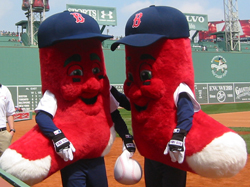
Lefty & Righty: On Transgendered Mascots

Leftyrighty LEFTY: Shortly after I became a full-fledged mascot, just days from being less than mote of lint on the knitting needle of my maker, I felt pressure from society to be a boy or a girl. “You have such pretty smile,” they’d say. “That must mean you’re a girl.” Or, “What a masculine chin you have; you’ll make a strapping young man.”

Things just aren’t so cut and dry these days. Mascots the world over are exerting their right to express or renounce the gender roles ascribed to them. The equipment you’re given should not determine if you entertain in a masculine or feminine manner. Really, what constitutes what is manly or womanly anyway? These characteristics originate in societal norms and perceptions and are not essential aspects of nature.

I think the best mascots traverse gender roles with a blink of their ostrich feather eyelashes. One second you’ll see the Phillie Phanatic flirting with an umpire and the next it’s ogling a female fan in the stands. (Hmm, notice how it is just assumed that an umpire would be male? Anyway, that’s another topic for another week.) Would anyone question the fitness of the Hall of Famer Philadelphia Phillies mascot as a role model for children?

On behalf of the Phanatic and other gender-oppressed mascots, I proclaim: “Philadelphia freedom!” From restrictive gender stereotyping, that is.

RIGHTY: God made men and women separate and different for a reason. Now people make a mockery of this symmetry with these polymorphously perverse mascots. In Cincinnati, this Gapper character traipses about the field. But what is it? Man, woman, something in between? It’s very undefined nature will rend asunder society as we know it.

If you go up to Milwaukee, you’ll see a real man’s man, Bernie Brewer. Down in San Diego, they have the Swinging Friar, another perfect paradigm of the properly demarcated and different positions men and women should have in today’s world.

We’re role models for children. It’s confusing enough to be a child in such perilous times. Predators lurk everywhere, from the dark corners of suburbia to the weekend getaway beaches. Have you seen the increasing rates of bear and shark attacks?

Indeed, it’s dangerous to be a child these days. Which is why we shouldn’t be distracting them by filling their heads with willy-nilly notions of it not being important if you’re a boy or a girl. Of course it’s crucial; how else will children know whether to seriously pursue a career like a man or learn the intricacies of housekeeping and raising children as a woman? Let’s save them a lot of needless stress and worry. Show them what they should be, not what they can be.

Lefty & Righty is a blatant rip-off of the Onion’s Point/Counterpoint feature, but new and improved with the inclusion of Red Sox mascots. Love it, like it, hate it? Let me know if you think this should be a regular.

LEFTY: Mascots the world over are exerting their right to express or renounce the gender roles ascribed to them. RIGHTY: God made men and women separate and different for a reason. Now people make a mockery of this symmetry with these polymorphously perverse mascots.

Flu

Game 17: April 21, 2006
Red Sox (11-6), 6
Blue Jays (8-7), 7

BS: Mike Timlin (2)
L: Keith Foulke (0-1)
W: Justin Speier (1-0)
12 innings

The Red Sox were afflicted by a variant form of avian flu last night. The Blue Jays proved that they are indeed an offensive force to be reckoned with, doing their best impression of the 2004 Red Sox with their come-from-behind, extra innings win.

One good thing coming out of the marathon meeting is the possible injury of A.J. Burnett. The big ticket free agent pickup exited before the fifth inning after just 78 pitches with elbow discomfort. He gave up a pair of two-out home runs to Boston’s dynamic duo of David Ortiz and Manny Ramirez. Should this be a long-term injury Burnett, Toronto may prove to be more vulnerable without their ace tandem. But their bats could carry them through the lack of pitching.

In fact, until the twelfth and final inning, all runs had been scored because of roundtrippers. Ramirez gave fans in the right field stands two home run ball souvenirs for the first time this season and Ortiz added another four-bagger to his gaudy numbers. Not wanting to be left out of the barrage, Jason Varitek notched his first homer of the season in the sixth.

In the top of the eighth, did Jerry Remy make a fat joke about Josh Beckett? The color guy said, “Beckett, sitting on the bench, enjoys a little cushion in this game.”

That little cushion was quickly flattened. Beckett commenced the inning by hitting Aaron Hill. Home plate umpire Jeff Kellogg immediately warned both dugouts because Alex Gonzalez had been hit by Jason Frasor in top half of the inning. The supposed retaliation proved Beckett’s undoing. Russ Adams, Vernon Wells, and Troy Glaus all homered in the eighth to tie the score, 6-6.

Except for the errant throw by Mike Lowell to J.T. Snow in the eighth that allowed Shea Hillenbrand to reach base, the Red Sox defense displayed its acuity. Lowell played the artificial turf to his advantage in the third inning; after snaring Hill’s grounder, the third baseman bounced the ball to first from his sitting position on the infield, knowing that the fast surface would carry the ball to Kevin Youkilis’s glove. In the fifth, Youkilis himself flashed the leather. He ranged to right for another Hill ground ball and tossed the retrieved orb over to Beckett, who managed to win the footrace to the bag despite his cushion.

With the bullpens depleted, the Red Sox and Blue Jays meet this afternoon for the pivotal middle game of the series. I’m beginning to find the Canadian team more compelling and menacing than that other team somewhere south of Boston, even if Burnett has to sit out for a number of months.

April 21, 2006

Dave’s Diegesis: What the Muck?

Deliver me out of the mire,
and let me not sink:
let me be delivered from them that hate me,
and out of the deep water
Psalm 69:14

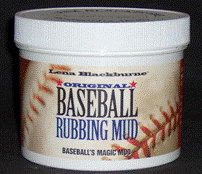
If you’ve ever been lucky enough to snag a foul ball or gopher ball in the stands, you would have noticed it’s not flawlessly white, even if it it hadn’t been through the rigors of play. This is because every ball used in major and minor league play is first treated with Lena Blackburne Original Baseball Rubbing Mud.

To make myself useful around the Red Sox clubhouse, in case I get a call that they need help or whatnot, I’ve been teaching myself some new skills that may come in handy. One thing I’ve been mastering is the art of rubbing baseballs. But before one acquires the expertise necessary to prepare a ball for play, one must understand who Lena Blackburne is and what makes him famous.
Blackburne started off as a shortstop for the Chicago White Sox in 1910. In the course of his 17-year career the itinerant infielder also played for the Cincinnati Reds and the Boston Braves. After his playing career ceased, he settled in as the third base coach under Connie Mack for the Philadelphia Athletics from 1933 to 1954.

At the time, there was no standard substance with which to de-slick balls. You see, new baseballs are just too shiny and slick for pitchers to grip. Umpires would use everything from tobacco juice to shoe polish, but nothing donned the ball with the right touch. Blackburne took it upon himself to find the alkahest to the pitchers’ baseball woes.

Somewhere ensconced in the anonymous mires of a Delaware River tributary there is a sanctum of incomparable muck. Blackburne chanced upon this champion lode of ooze that was perfectly suited to the task of breaking in balls. It enrobed the ball with its smooth consistency, described as a cross between “chocolate pudding and whipped cold cream.” By 1938, Blackburne supplied the American League with his clandestine conconction. Being a stalwart supporter of the American League, he actually refused to sell the mud to the National League until the 1950s.

I don’t like to turn to our divisional rivals, but in this situation I had to seek the supreme guru of craft. I went Baltimore on a sojourn to mentor with Ernie Tyler, ball man. Mr. Tyler, the real iron man of the Orioles, has worked 3,699 consecutive games as of April 20th. He has been with the team since 1954 and has been the clubhouse attendant since 1960. Mr. Tyler likes to prepare around 80 balls a game, but for Fenway, I would up it to 100. Not only does one ensure a uniform color and texture, but one must also check for defects on the spheres. The omniscient slime exposes blemishes that would otherwise go unnoticed.

It’s odd how, in this case, you must sully something to make it proper.

Every Friday, Dave McCarty will join us to discuss a topic of interest to him and probably no one else but the author of this site and perhaps some readers of the Boston Phoenix.

Outage

Game 16: April 20, 2006
Devil Rays (8-8), 5
Red Sox (11-5), 1
W: Scott Kazmir (2-1)
H: Travis Harper (1)
S: Dan Miceli (4)
L: Tim Wakefield (1-3)

After this game, the fans who gathered to bid farewell to the players noted that Tim Wakefield’s SUV had a bumper sticker that said “Got runs?” Whenever Wakefield walks past Matt Clement, he pulls out the inside of his pant pockets and holds up a piece of cardboard upon which is scrawled, “Sober, drug-free. Need runs to support family. Thank you and God Bless.” The knuckleballer went eight innings with a line of eight hits, three runs (two of them earned), two walks, two strikeouts, and one gigantic homer launched by Jonny Gomes in the seventh inning.

Gomes was in peak form in the late innings; both his homers were crushed over the Sports Authority sign on the Monster and both were the first pitch of his at bat. If Gomes played for a big market team, the press would be clamoring for sound bites from the toast of the town batsman. The slugger was in contention for the AL Rookie of the Year award last year, finishing third behind Huston Street and Robinson Cano. He garnered two first-place votes and 39 points for his 21 roundtrippers, .372 OBP, and .534 slugging. Cano finished second with 14 homers, .320 OBP, and .458 slugging. See what media exposure can bring you?

Speaking of overlooked Devil Ray players, Scott Kazmir pitched an outstanding five and two-thirds innings, striking out seven hitters. The capable southpaw continued to confound our best hitters: David Ortiz and Manny Ramirez struck out one time each. Kazmir did walk Ramirez in the sixth inning and was subsequently pulled from the because of a possible injury.

Perhaps one of the highlights of the evening was the tug-of-war between two spectators for Josh Bard’s bat in the second inning. You could call it the “Bat-Tle Royal.” Or “The Rumble for the Lumber.” Bard was fine with not having the bat; he wasn’t using it anyway.

Willie Harris made is Red Sox debuted in the seventh inning as a pinch hitter for Wily Mo Peña. The veteran utilityman was brought up to replace Adam Stern, who will get more frequent playing time in Triple-A Pawtucket. Harris struck out in his two at bats.

The Red Sox failed to secure their second series sweep. Games like these will happen, but what is of greater concern is the utter inability of Tavarez to get a batter out. He relinquished a home run and two doubles, which amounted to two earned runs.

April 20, 2006

Moxie

Game 15: April 19, 2006
Devil Rays (7-8), 1
Red Sox (11-4), 9
L: Doug Waechter (0-1)
W: Curt Schilling (4-0)

Cast
Tina Cervasio, ingénue under pressure
Don Orsillo, starstruck announcer boy
Jerry Remy, grizzled veteran
Rene Russo, established Hollywood starlet
Ty Wigginton, Devil Rays utilityman

[Cheesy infotainment musical opening. Flashy graphics package swoops across the screen trumpeting “Red Sox Moxie,” a show where baseball and celebrities collide.]

ORSILLO: Good evening, everyone, and welcome to the second game of a three-game series against the Devil Rays. When Boston last tangled with Tampa Bay, tempers flared and suspensions were delivered. [Clip of the Julian Tavarez/Joey Gathright incident.] Jerry, what can we expect from this match-up?

REMY: Well, Don, the Devil Rays have new ownership and management, but all of the same old problems. They’ve got a stacked lineup, particularly in the outfield, but no pitching. Tonight’s starting pitcher, Doug Waechter, has started two games and has no wins. So far this season he’s pitched for nine and two-thirds innings with a 3.72 ERA.

ORSILLO: That’s not too bad.

REMY: Well, it’s good for the Devils Rays’ pitching staff.

ORSILLO: This is true. Tina, you’ve got some news for us?

CERVASIO: Thanks, Don. I was talking to some Devil Rays players before the game and they tell me playing for a new owner, general manager, and field manager has been uplifting so far. The Devil Rays squad tells me that because expectations are low, the team doesn’t feel the pressure that one would in a high-profile franchise where every person associated with the team is analyzed daily under a microscope.

[Cut to interview clip of CERVASIO with TY WIGGINTON.]

CERVASIO: So, what’s the real estate market like in Florida?

WIGGINTON: Real cheap. And you know there’s no state income tax.

CERVASIO: And they’re as laid back as you say they are?

WIGGINTON: Yeah, nothing like Pittsburgh. That place was like a pressure cooker. This place is like so intense. I don’t know how I’m going to handle playing in left field here. Those fans over there [gestures to CVS Family section] are all over me.

[Cut back to ORSILLO and REMY.]

ORSILLO: Quite interesting.

CERVASIO: [Uncharacteristically glum.] They tell me that no one even knows the name or even cares about the sideline reporter on their local broadcasts.

ORSILLO: Thanks very much, Tina. I hear you have a noteworthy guest with you today?

CERVASIO: In Tampa, there’s no “Weiner Whiner Line” that ridicules you, or fan message boards that criticize every aspect of your performance on a nightly basis.

ORSILLO: I see. And your surprise guest...?

CERVASIO: Nope, no pressure in Florida. Plus, a lot of the folks I know from New Jersey live down there already. It’s like Yankee Stadium south.

REMY: Lots of snowbird retirees down there. All pulling their pants up high, like the new Wally. Don’t forget, you can get Wally and other fine merchandise at The Remy Report. Early bird menu not included.

ORSILLO: [Clears throat.] So, Tina, I hear you’ve got film star Rene Russo with you.

CERVASIO: [Suddenly chirpy.] Rene Russo, star of the Lethal Weapon and Major League series, is here tonight. So, how do you feel about being here at Fenway?

RUSSO: It’s just great. I came specifically to be here and finally watch a game in person.

CERVASIO: Do you have any predictions for this game?

RUSSO: Schilling’s going to go six innings with six hits, one earned run, one walk, and seven strikeouts.

CERVASIO: Which Red Sox batters do you think are going to score a lot of points?

RUSSO: You mean runs? Well, I think Youk is going to continue on his tear and go three for four with two RBIs, including a homer. Lowell will abuse the wall with his line drive doubles and also drive in two runs. I’ve been keeping my eye on that Wigginton kid. He’s all shook up about his first start in the outfield here, so look for him to commit some key errors.

CERVASIO: Back to you, Don and Jerry!

ORSILLO: [To production crew.] Could you send Rene Russo to the booth? I’d really love to take a picture with her....

[REMY rolls eyes.]

April 19, 2006

Duple

Game 14: April 18, 2006
Devil Rays (7-7), 4
Red Sox (10-4), 7
BS: Scott Dunn (1)
L: Ruddy Lugo (0-1)
BS, W: Mike Timlin (1, 2-0)
S: Jonathan Papelbon (7)

It was a night of defensive marvels that one doesn’t usually expect from a Red Sox/Devil Rays match-up. Jerry Remy was amazed by the defensive alignment Joe Maddon devised for David Ortiz. The Tampa Bay field manager had four outfielders and also had his second baseman fairly deep in right field. Remy could only recall a similar blueprint for Jim Rice, but reversed for the right-handed hitter.

Ortiz’s strategy to beat the shift in the third inning? With two outs, he slammed a wallball double. The Red Sox designated hitter was driven in by Manny Ramirez’s liner that just inched past Carl Crawford’s glove. Ramirez also notched two more RBIs in the seventh inning in response to Tampa Bay taking the lead at the top of the inning. With runners on second and third with two out, Ramirez’s liner bounced off of right fielder Russell Branyan’s glove and was ruled a single.

I wonder how Ruddy Lugo got his job? He’s not related to anyone famous, is he? Julio Lugo’s younger brother entered the game in the bottom of the eighth after his team had tied the game in the top of the inning. He quickly gave up a wallball double to Mike Lowell and walked pinch-hitter Trot Nixon on five pitches. The younger Lugo then left the game with runners on first and second with no out for Chad Orvella, who was just recalled from the triple A Durham and is one of the few potential bright spots in the Devil Rays bullpen.

Adam Stern attempted a sacrifice bunt to advance the men on base but ended up deleting Lowell from the equation. Alex Gonzalez put up a fight against Orvella by fouling away four pitches but struck out swinging. The stage was set for Kevin Youkilis, who had grounded out in his first two at bats but then singled and walked. He jetted the ball off the Monster more towards center than left field to drive in two runs for the lead. Mark Loretta singled a grounder into the opposite field to plate Youkilis, tacking on another run.

The Red Sox did not record an error in the game, continuing to play crisply on the field. In the fifth, Ramirez played the wall with his usual aplomb, catching the carom of Toby Hall’s fly ball off the wall barehanded and returning it to the infield rapidly, limiting the Devil Rays catcher to a single. Hall was then thrown out at second by Jason Varitek on a failed hit and run play. Clement also fielded his position well in the seventh. He fielded a Joey Gathright ground ball Clement wisely opted to get Tomas Perez out at second, which both reduced the risk of a close play at first base and erased the runner from scoring position.

Despite the outstanding play of the defense, a potential weakness in the bullpen was exposed. Mike Timlin blew the first save for Boston this season in the eighth inning. He walked Travis Lee on four straight pitches and gave up doubles to Jonny Gomes and Branyan, who tied the scored 4-4 with his RBI double. Hopefully Timlin’s shaky outing won’t be indicative of future performance or a sign of veteran pitcher being overused.

One can’t speak of defense without mentioning the defensive play of the game, and according to my opinion of not ESPN’s, the Web Gem of the night. Jonathan Papelbon was in danger of blowing his first save of the year. After striking out Gathright on three pitches, Papelbon allowed Crawford to reach on a single up the middle. The young closer also struck out Jorge Cantu, but not after throwing nine pitches to the persistent second baseman and also allowing Crawford to reach second. Lee then walked on 10 pitches and Gomes on five to load the bases. Damon Hollis, who came into the game in the eighth as a pinch runner, fell behind 0-2 in the count before winging the ball into shallow center for what appeared to be a certain hit. Center fielder Stern had other plans, however, diving for the cambering ball just before it touched the turf.

Instead of this brilliant catch to save the game, however, ESPN opted to highlight Johnny Damon’s collisions with the outfield wall. Go figure. It’s probably just an effort to stoke the flames of the rivalry.

April 18, 2006

Untie

Game 13: April 17, 2006
Mariners (6-8), 6
Red Sox (9-4), 7
H: Jake Woods (2)
BS: J.J. Putz (1)
BS, L: Eddie Guardado (1, 0-1)
W: Mike Timlin (1)

Have you ever witnessed something so perfect and of such beauty that you were hesitant to commit words to paper, brush to canvas, voice to notes, for fear of failing utterly in the attempt to convey what you saw?

It’s no stretch to say that, after 2004, all Red Sox fans share this in common--a far better legacy than contrived curses or maladroit management. When you see something so wonderfully implausible, you wonder if, in the retelling, some of that magic will dissipate. But then you realize, no, you should recount said events, even if only for the selfish pleasure of reliving such feats.

The comeback win on Patriots Day had a trace of July 24, 2004 about it. Sure, it’s only April and it was against the Mariners. But when there are retrospectives of 2006, this game could be heralded as the game where everything came together.

Lenny DiNardo made his second major league start, a sport start in a top-heavy pitching rotation. I did see his first start in September of last year; I wish I could have been on hand for his second. He went five innings with a line of six hits, two earned runs, and one each of bases on balls and strikeouts.

The Mariners scored first thanks to Ichiro Suzuki hit DiNardo’s second pitch over Manny Ramirez, who, as usual, was playing shallow, for a leadoff double. Ichiro, who could advance a base when a pitcher scratches his nose, proceeded to third base Jose Lopez’s 1-3 ground out. Raul Ibanez then lofted a sacrifice fly to left field, Ramirez at the ready for a play at home. The left fielder’s throw was accurate but Suzuki was too fast. 1-0, Mariners.

Gil Meche is one of those run-of-the-mill righties hitters like David Ortiz feast on. With two out and the count full, David Ortiz propelled a ball into the camera hut in the center field bleachers to tie the game going into the second inning, 1-1.

Adrian Beltre reached first DiNardo’s only walk of the game. It would prove costly as Seattle’s third baseman scored on Yuniesky Betancourt’s fly ball double to center field. Alex Cora displayed transcendental game awareness when netting Suzuki’s grounder: instead of attempting to throw to Kevin Youkilis to get the out at first, he trapped Betancourt in a rundown. Cora along with infield accomplices Mike Lowell and Mark Loretta ensnared the sophomore shortstop for the third out of the second inning. Suzuki was left stranded at first, but the Red Sox failed to keep the game tied. Seattle led 2-1 going into the bottom of the second.

Perhaps overly anxious after his brief respite, Trot Nixon fell behind 0-2 in his first at bat. He then evened the count watching two pitches miss low. Meche tried to go low and away, but Nixon was able to single to right field and advanced on Jason Varitek’s ground out to second base. The Boston right fielder was perfectly positioned to score on Cora’s short fly to center. The Mariners’ second baseman Lopez had pursued the ball just deep enough into the outfield to allow Cora to leg out a double since none of Lopez’s infield covered second base on the play.

The game would remain knotted at 2-2 until the sixth inning. Rudy Seanez struck out the first two batters he faced, Ibanez and Richie Sexson, with just 10 pitches. Then rookie catching standout Kenji Johjima (called variously by Jerry Remy as “Joe Jama” or “Jojimer”) dispatched a fly ball single to center field, scoring when the all-too-familiar Carl Everett jacked a two-run roundtripper off Pesky Pole. The teeter-totter tipped again in the Mariners’ favor, 4-2.

The Red Sox played “our DH is better than your DH” in the bottom of the sixth. Ortiz retorted with a two-run blast of his own with Youkilis on base. Boston could have taken the lead had Ramirez’s fly ball off the wall not missed clearing the Monster by just a foot. Instead, the game headed into the seventh inning with a 4-4 draw.

The tie was quickly effaced. Cora, despite his earlier heroics, erred on a Willie Bloomquist liner. The Mariners utilityman went then went station to station on a Betancourt sacrifice bunt, stole third base, and scored on Suzuki’s ground out to second base.

Trailing 5-4, Ortiz nearly evened the score again with his olympian fly ball to right. Instead, Suzuki cleanly fielded the ball just in front of the visitors’ bullpen. Nixon then proved that the rest did not rust his skills; he placed himself into scoring position with a two-out double that bounded along the first base line before trickling into right field. Varitek’s gutshot grounder past the diving Lopez drove in Nixon to, yet again, tie the score.

Keith Foulke got Everett to fly out to left but then allowed two consecutive singles to Beltre and Bloomquist. Bloomquist’s single was a particularly sharp grounder up the middle that advanced Beltre to third base. With one out and runners at the corners, Mike Timlin entered the fray.

Timlin yielded the go-head run to pinch-hitting Roberto Petagine, who the Red Sox may have been more familiar with had he been allowed any playing time last season. Petagine’s ground out to second base scored Beltre. Suzuki was then intentionally walked to get to the slumping Lopez, who impatiently swung at every thrown pitch and quickly struck out.

Boston trailed 6-5 going into the bottom ninth inning. Wily Mo Peña and Dustan Mohr both struck out to Almost Everyday Eddie Guardado. The left-handed closer came within one strike of sealing the Red Sox’s fate, going up on Youkilis 0-2. But Youkilis muscled a ball into play on and just beat out a throw by Lopez for an infield single.

Loretta watched two pitches miss the zone and on the third pitch he saw hit his first walk-off home run at any level. His first circuit clout as Red Sox player soared into the Monster Seats to grant a fan a souvenir and a his team a win.

Like heavyweight fighters exchanging blows in a championship bout, each team rallied back after falling behind in a repartee of RBIs. Morever, the Red Sox proved they can win both tight games and offensive face-offs.

Is it really only April?

April 17, 2006

Boon

Game 12: April 16, 2006
Mariners (6-7), 2
Red Sox (8-4), 3
L: Jarrod Washburn (1-2)
W: Josh Beckett (3-0)
H: Mike Timlin (4)
S: Jonathan Papelbon (6)

Sometimes Jim Rice’s mixed metaphors are (unintentionally?) poetic. In the pre-game show to this game he said, “This is the time you have to put the nail in the coffin or they’ll come back to haunt you.”

Unlike Josh Beckett’s other two starts, the right-handed pitcher’s first inning was a walk in the park. Not that he literally walked anyone. Well, he did, but not until the fourth inning when Matt Lawton got a free pass. Beckett has been a big hit in Boston so far because he hasn’t given up a lot of them; just six in this game. The former Marlins pitcher has been on a great run (although he gave up just two runs, one unearned) as this is the first season he has started the season 3-0. After achieving prominence in the World Series, Beckett wasn’t known for striking out with ladies such as Leeann Tweeden; instead he struck out hitters, like the five Mariners he did on Sunday. Two of those strikeouts were key as they came in the sixth inning with a runner on third, one out, and the score 3-2. Beckett could have opened the door for Seattle to walk right back into the game, but he slammed it shut to end the inning.

Jerry Remy let slip that Tony Massarotti was the official scorer for this game. On the phantom safe call of Jason Varitek by first base umpire Rick Reed, Massarotti gave Adrian Beltre a throwing error rather than doing the homer thing and giving the captain a hit. In the second inning, Massarotti labeled Alex Gonzalez’s oddly hopping grounder as an error on Beltre rather than a hit. It almost seemed like Boston Herald scribe had it in for Beltre or just didn’t want to dole out Red Sox hits. Massarotti also charged an error to Mark Loretta in the third when the second baseman bobbled a grounder of the bat of Ichiro Suzuki. It probably would have been called a hit at Safeco. In his one act of mercy, Massarotti changed his mind on Wily Mo Peña’s dive for Raul Ibanez’s liner in the sixth inning. At first he called it a double and error, but he eventually changed it to a triple. Replays showed that Ibanez would attempt to leg out a triple no matter what Peña did.

The Red Sox bettered their one-run game record to 4-0, winning games on strength of pitching rather than offensive onslaughts. The home team scored early thanks to Kevin Youkilis leading off the game with a five-pitch walk. The leadoff hitter advanced on a Mark Loretta double that caught the bottom of the wall and then scored on Manny Ramirez’s ground out to first base. If an RBI could be granted to an umpire, Reed would be leading the league with his one-run miscall of the Varitek/Sexson play at first which scored Loretta.

Seattle responded with runs of their own in the top of the third inning. Suzuki reached on error and seemed to distract Beckett. After throwing pickoff, strike, pickoff, strike, ball, Jose Lopez got a hold of pitch and lined a triple into right field to score Suzuki. Ibanez then lobbed a wind-assisted RBI single to shallow center that eluded Gonzalez, which tied the score.

Gonzalez would use the wind, and a rookie center fielder’s inexperience, to his advantage in the fourth inning, however. Varitek poked a grounder just past Yuniesky Bentancourt’s outstretched arm for a single. After seemingly regaining his wits to strike out Mike Lowell, Jarrod Washburn proceeded to walk Dustan Mohr and hit Peña with a pitch to load the bases. Gonzalez came to the plate swinging, falling behind the count 0-2. On the fourth pitch he lofted what should have been a fly out to center but became an RBI single thanks to the buffeting gusts moving from left to right field. Jeremy Reed misjudged the strength of the win and, for the second straight win in a row, Gonzalez proved to be the difference maker.

Ramirez again showed flashes of brilliance on the field. With extended glove hand he caught Suzuki’s fly ball on the run as it trailed away toward the wall and to his left for the first out of the eighth inning. He then hauled in Ibanez’s slicing ball away on the backhand as it arced away from him towards the right. Peña could learn from his counterpart across the outfield.

The bullpen tandem of Mike Timlin and Jonathan Papelbon once again treated the fans at Fenway with a near-perfect pair of innings. I suppose they wanted to be sure that every Red Sox fan attending this homestand will get to see a Timlin hold and Papelbon save.

April 16, 2006

Almost Perfect

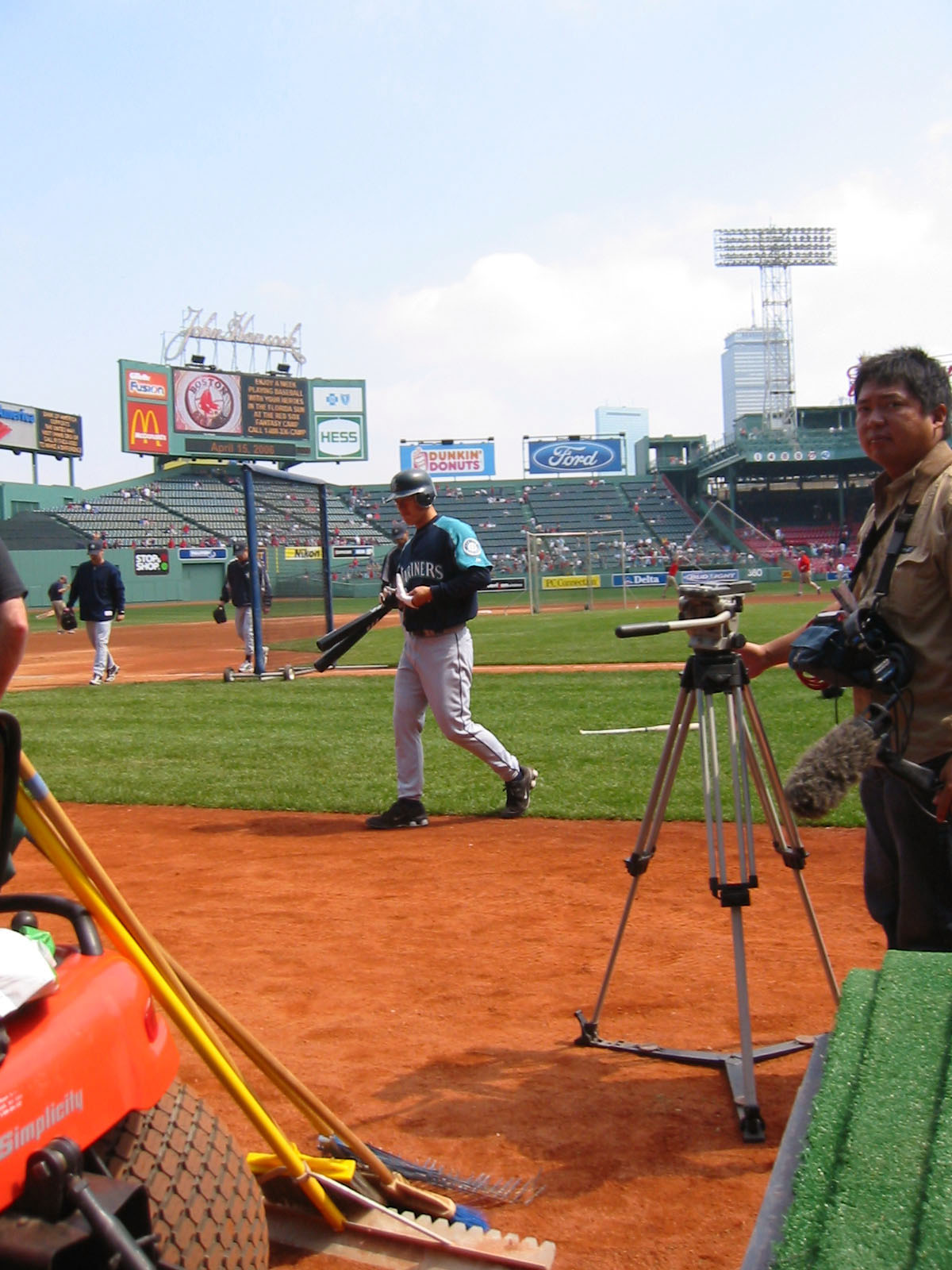
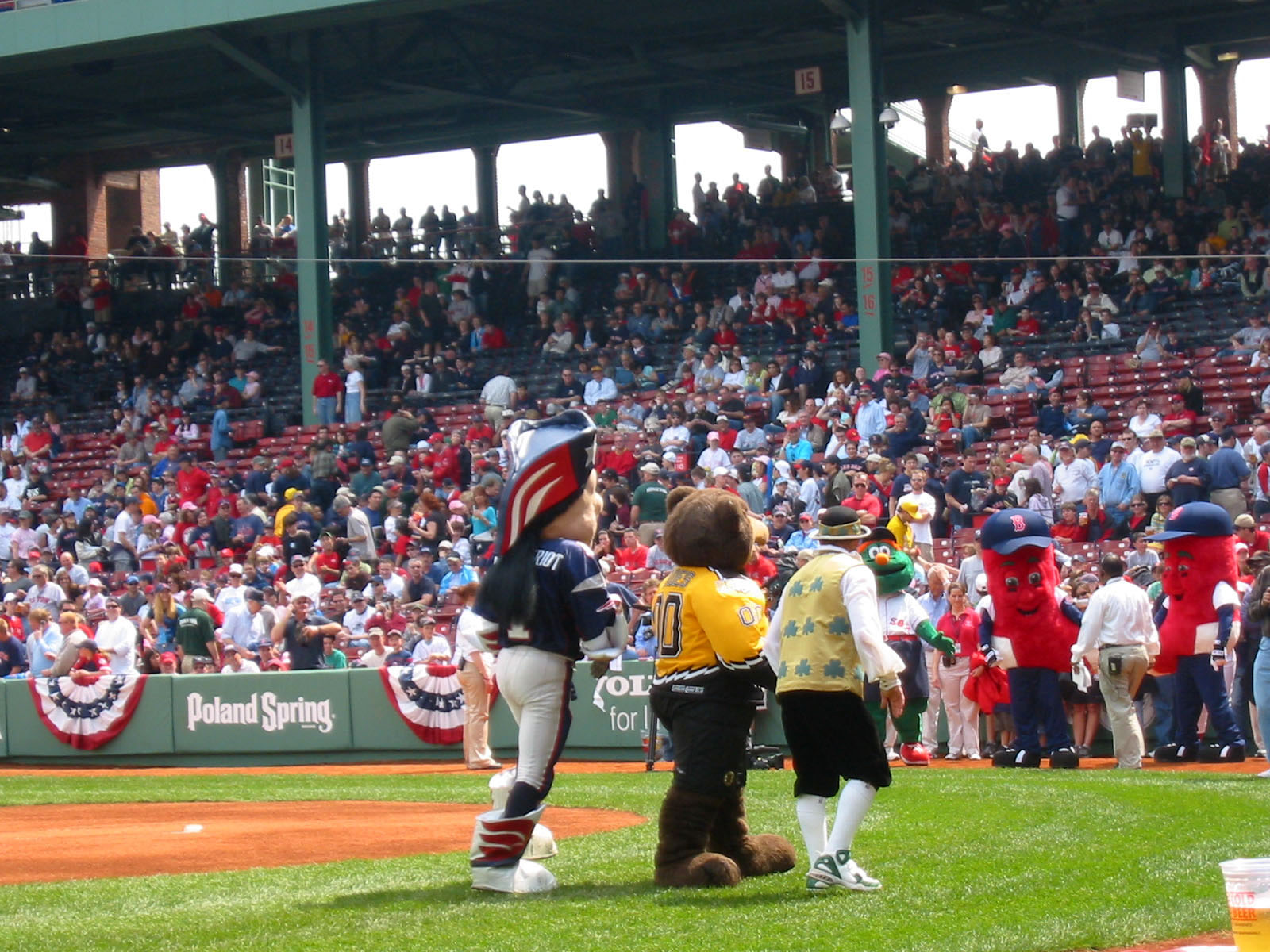
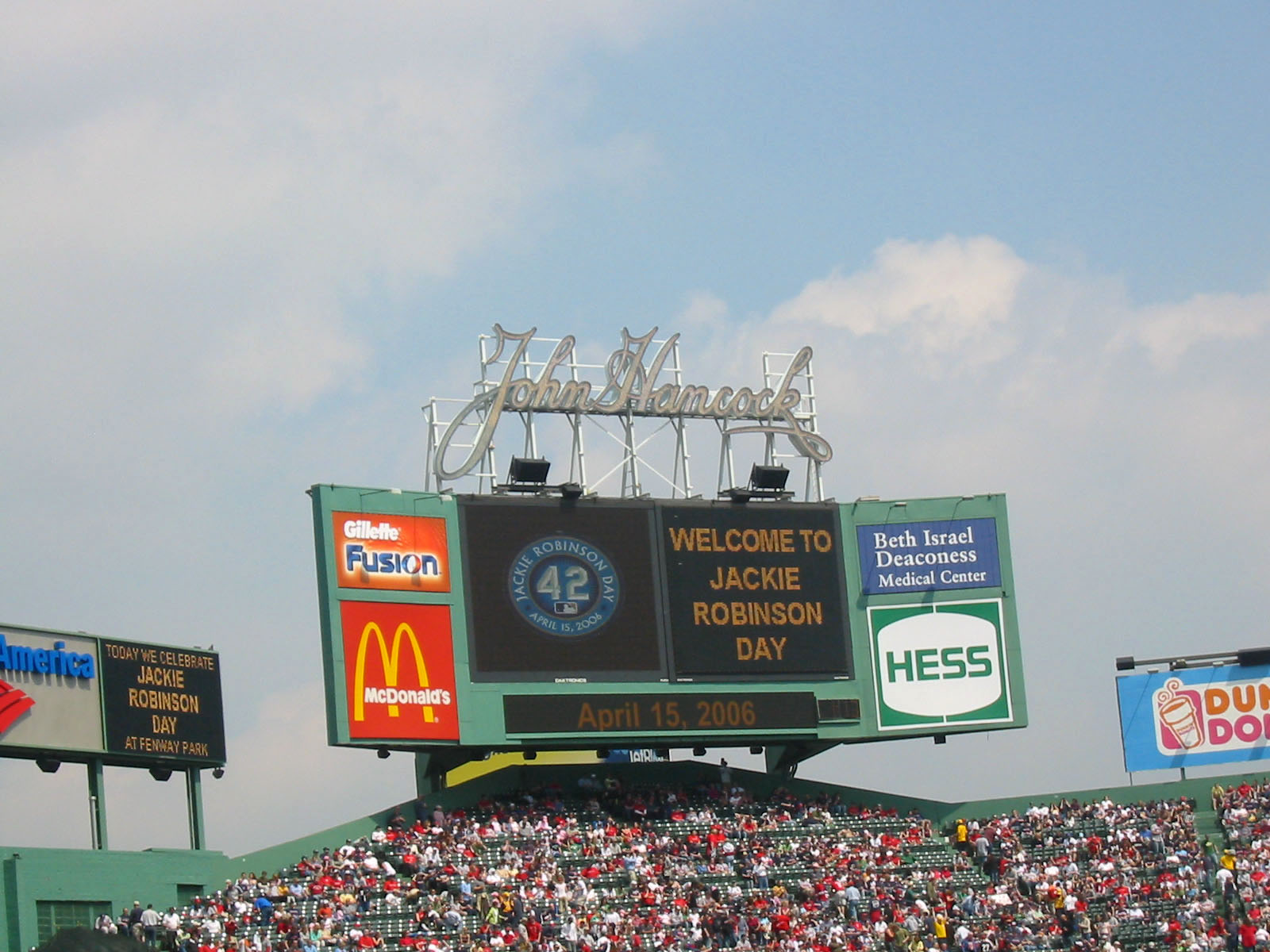
Saturday’s weather stunning although the game results were not. Jackie Robinson Day was celebrated throughout the league to honor the end of segregation in baseball. For the kids, it was Mascot Day and they got to run the bases after the game. There’s a disappointing lack of fundamentals in youth these days; I’d say less than 5% touched all the bases.

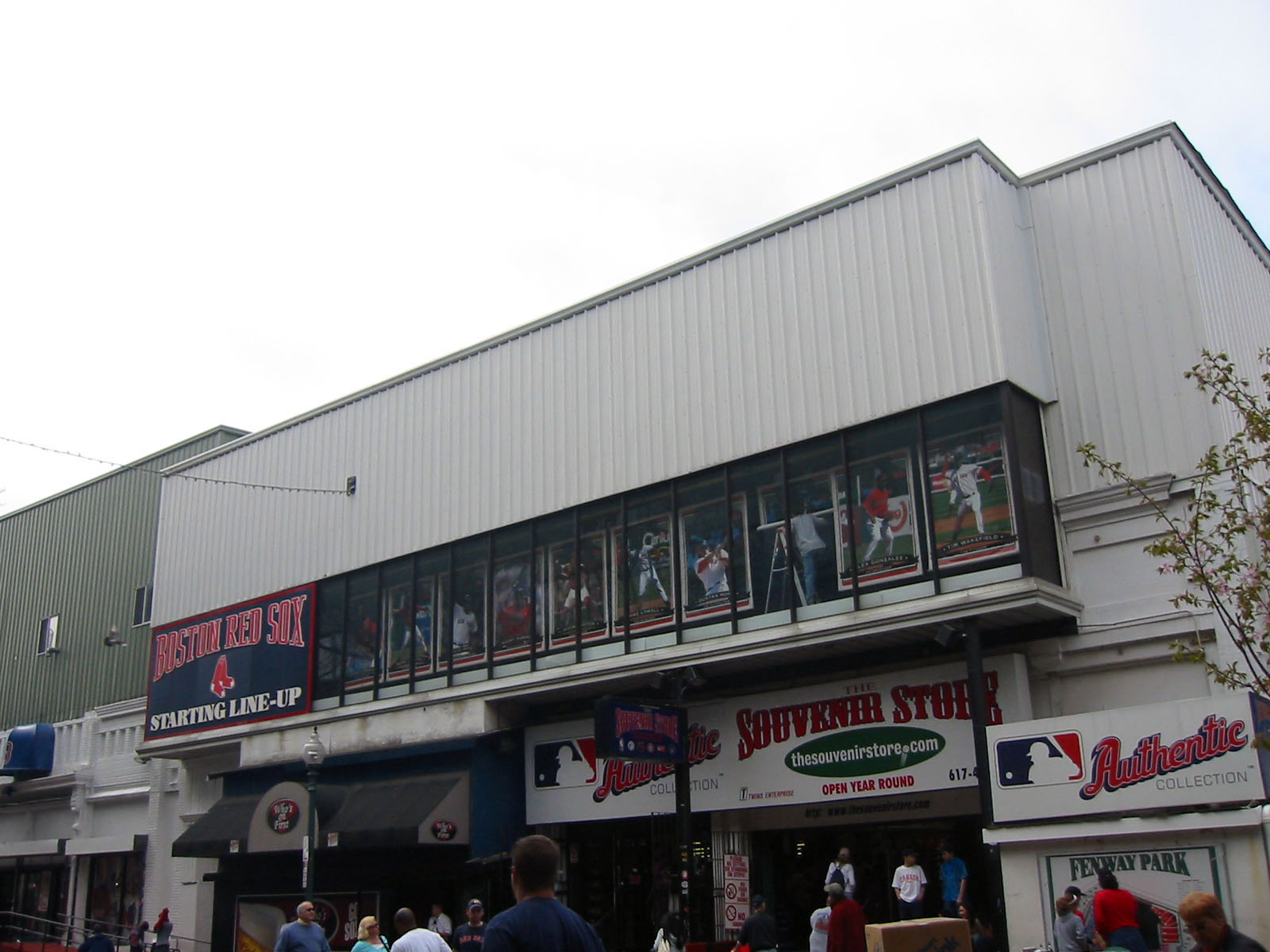
Lineup in the Windows
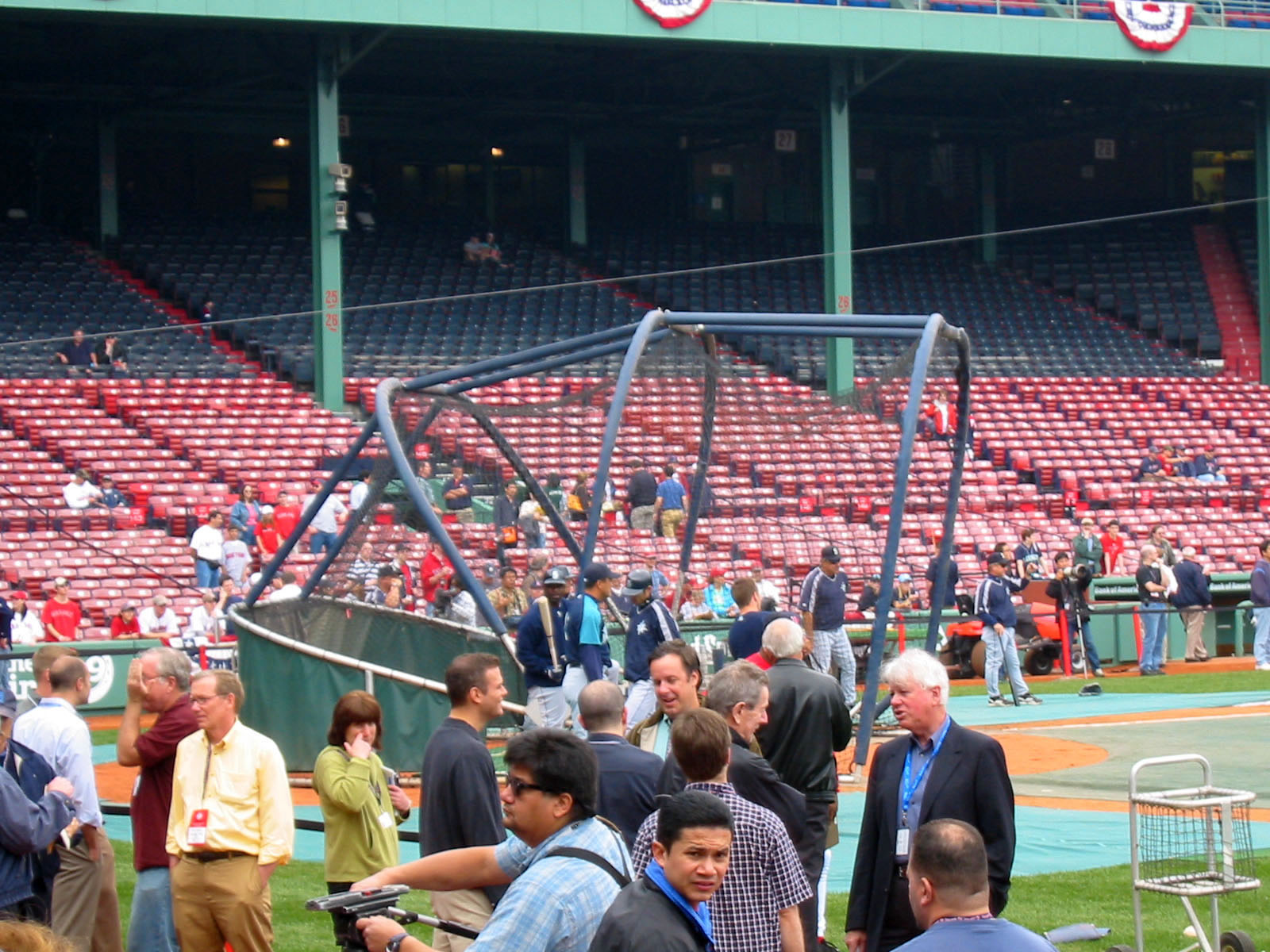
A sneak preview of the less-than-stellar lineup Terry Francona devised.

Lineup in the Windows
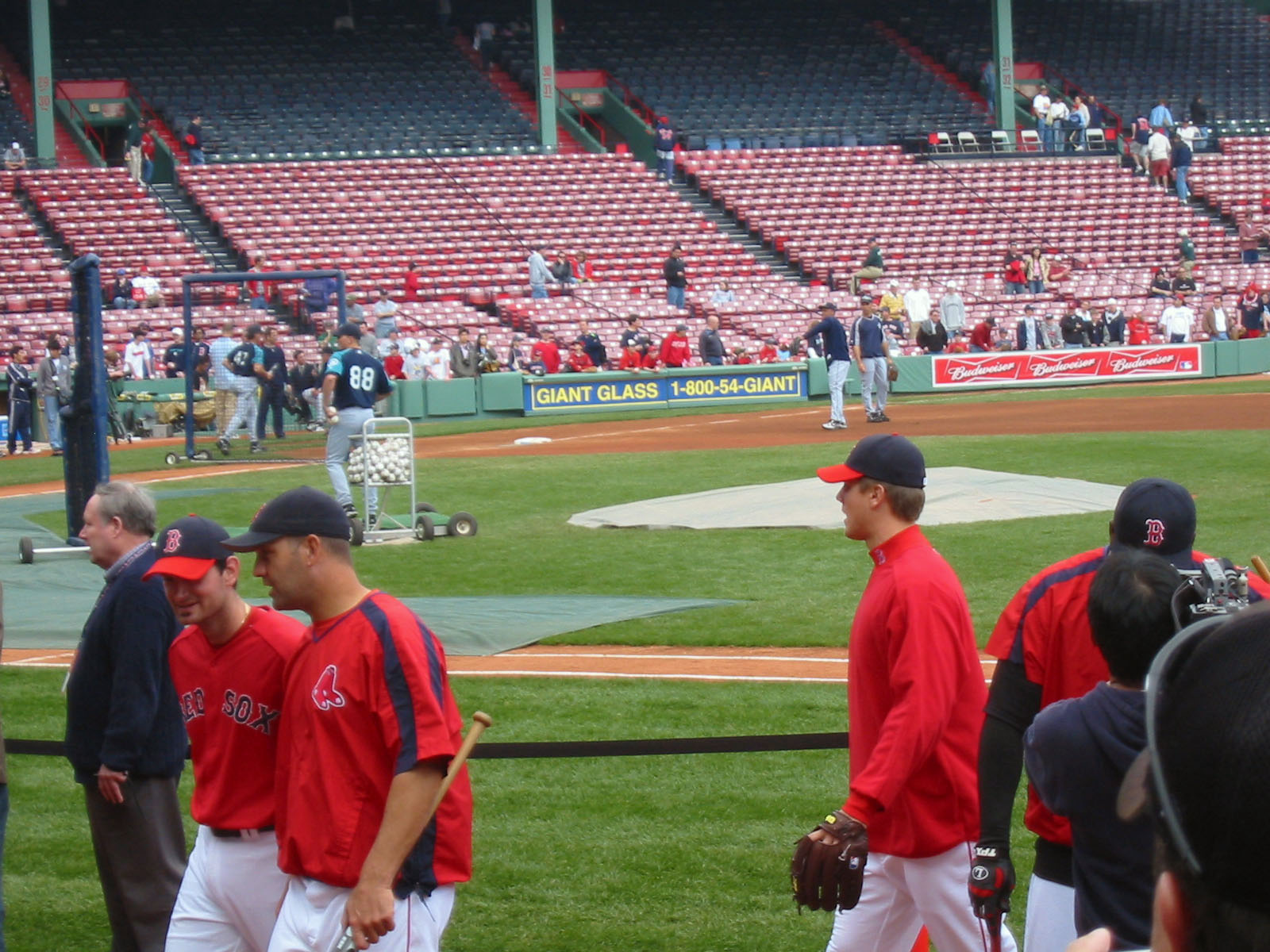
Julian Tavarez brags to Curt Schilling about the sprinkler he messed up real bad while they were walking in from the bullpen.

Fenway Matrix
The matrix has you.

Media Melange
Bob Ryan, Bob Neumeier, and others crowd the plate.

Closer
Did someone call a fireman?

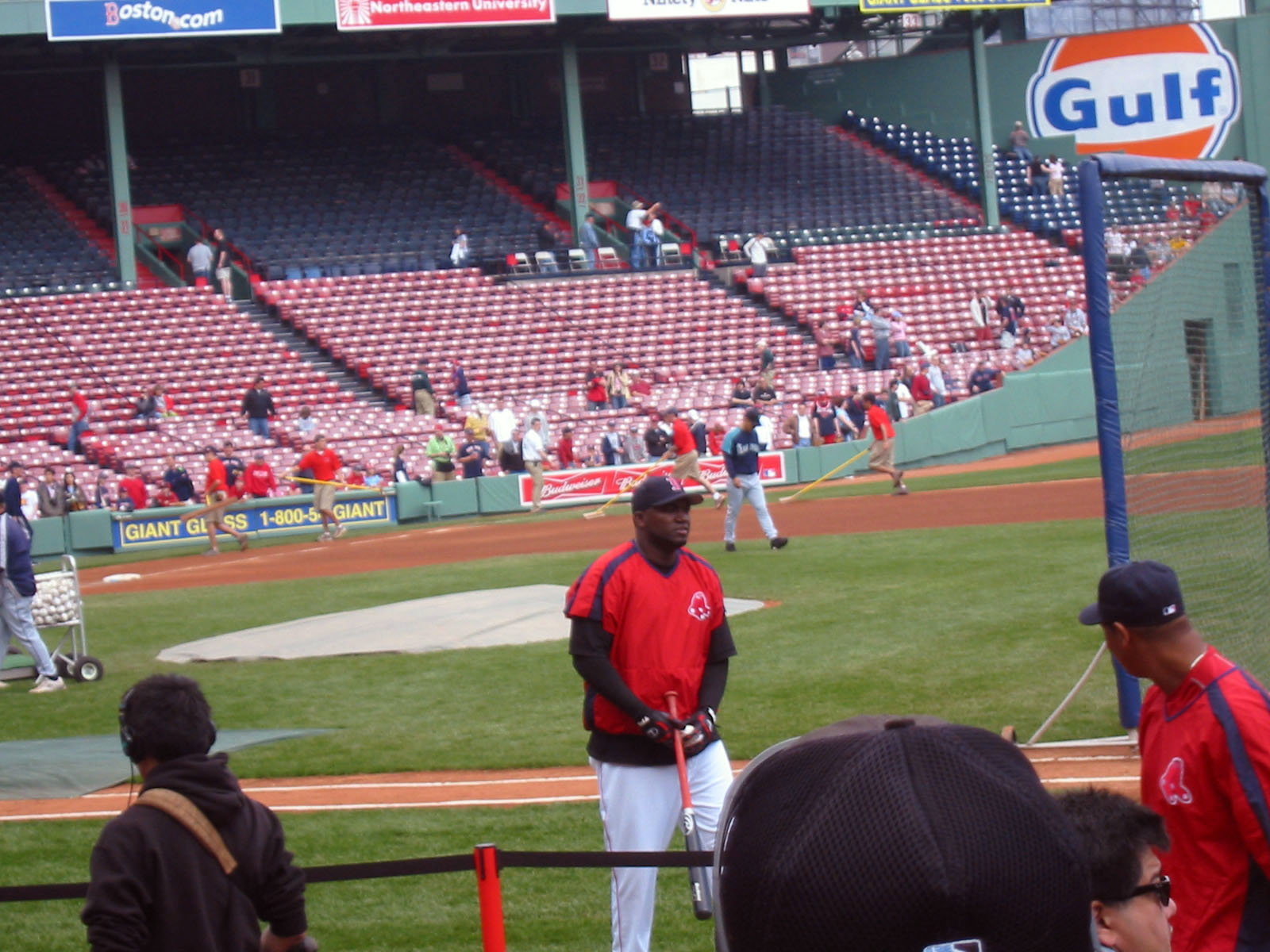
Big Papi
King David.

Sexson
I could not get Richie Sexson to fit in the picture.

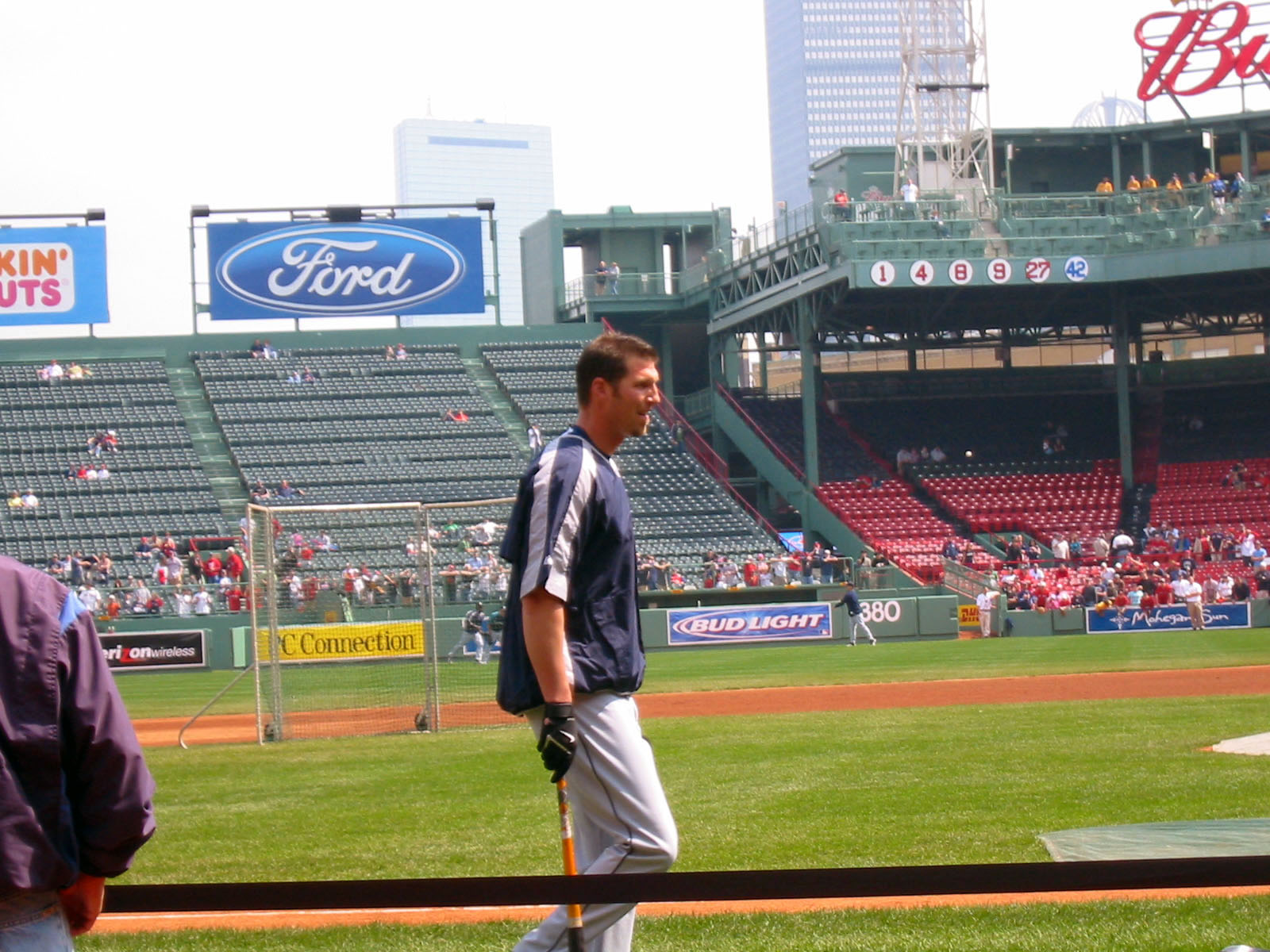
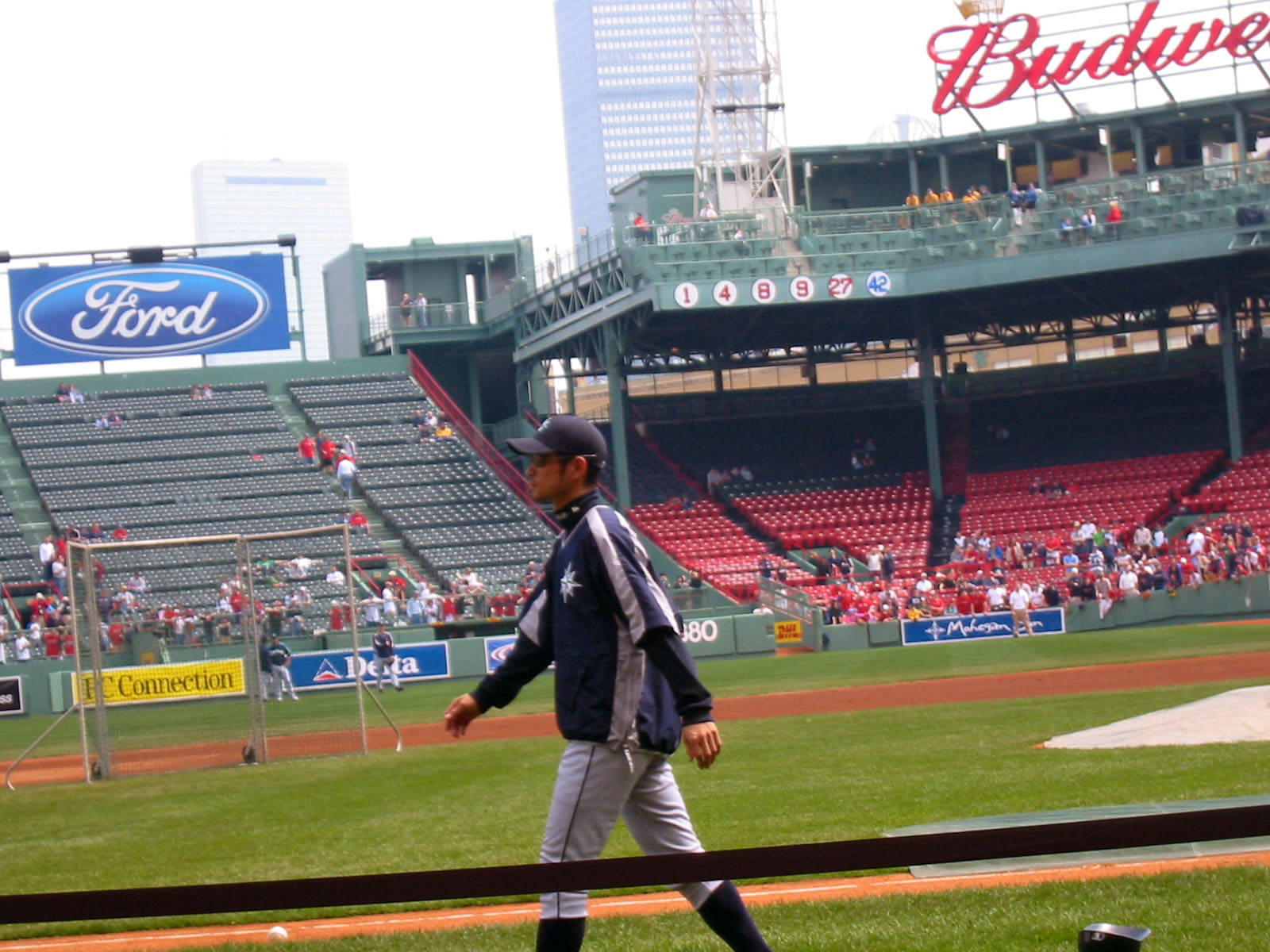
Ichiro
Here Ichiro Suzuki slowed down enough so he wasn’t blurry.

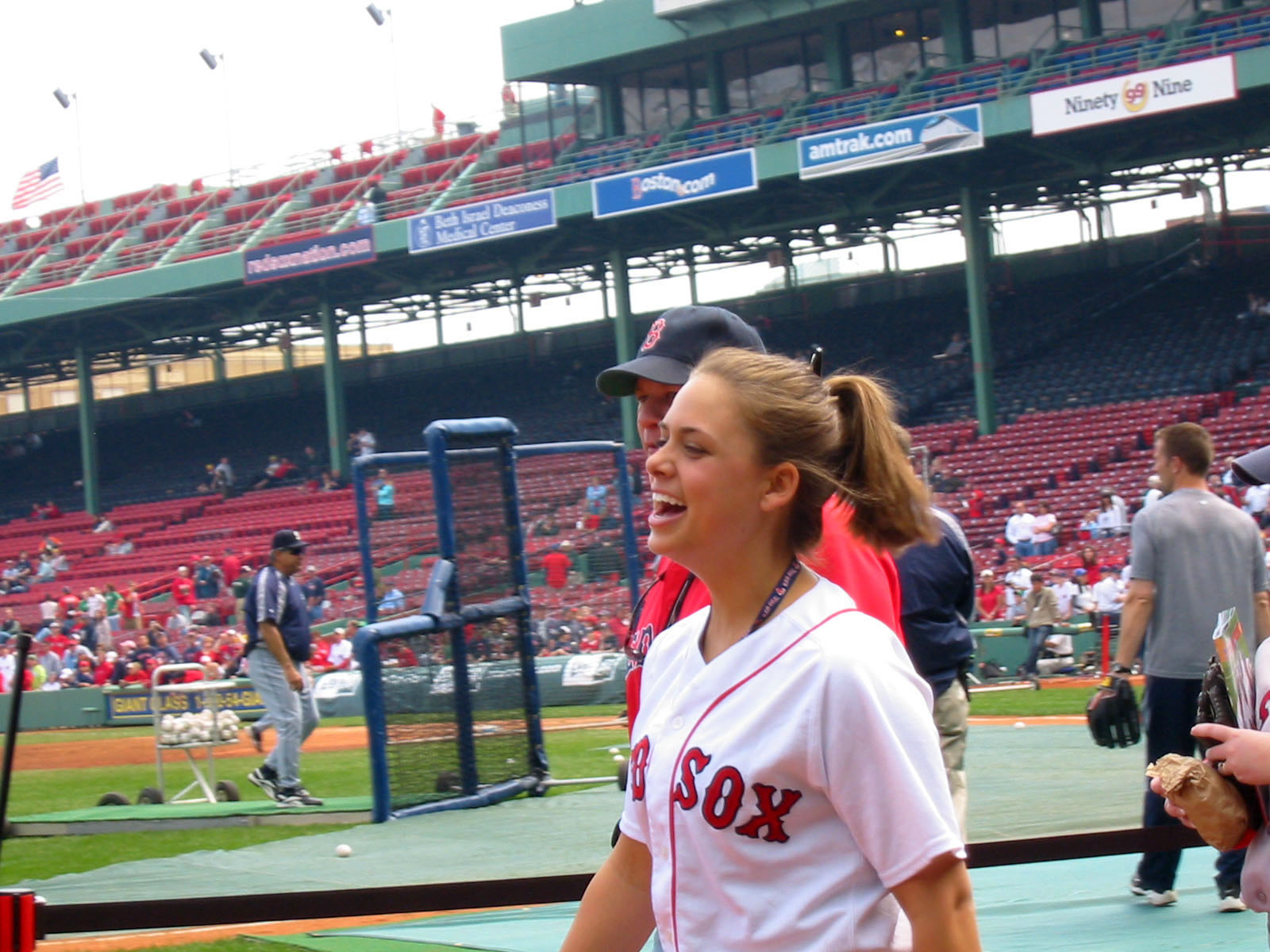
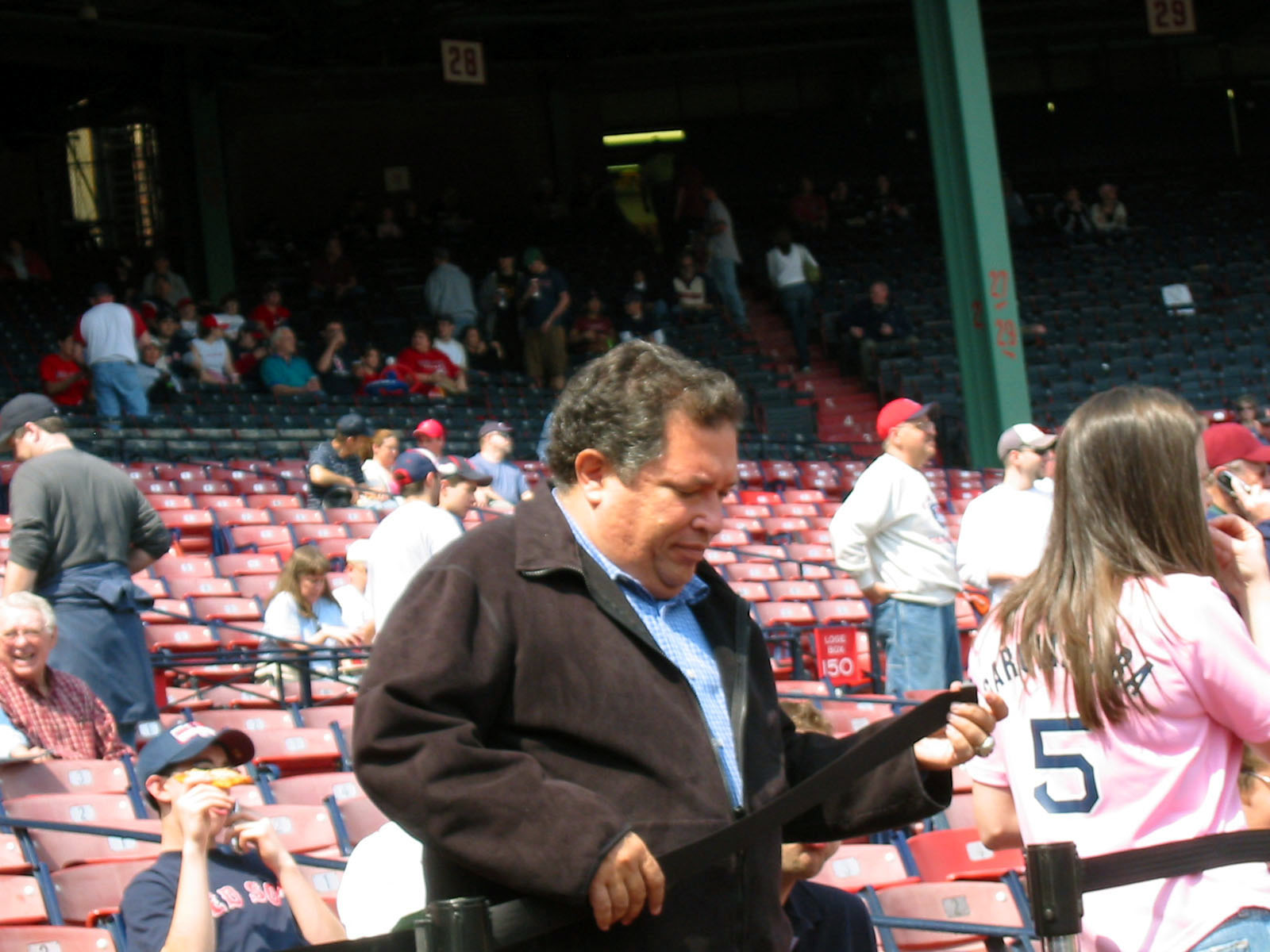
Kelly
Kelly, you make me feel so badly/
Why don’t you turn around?

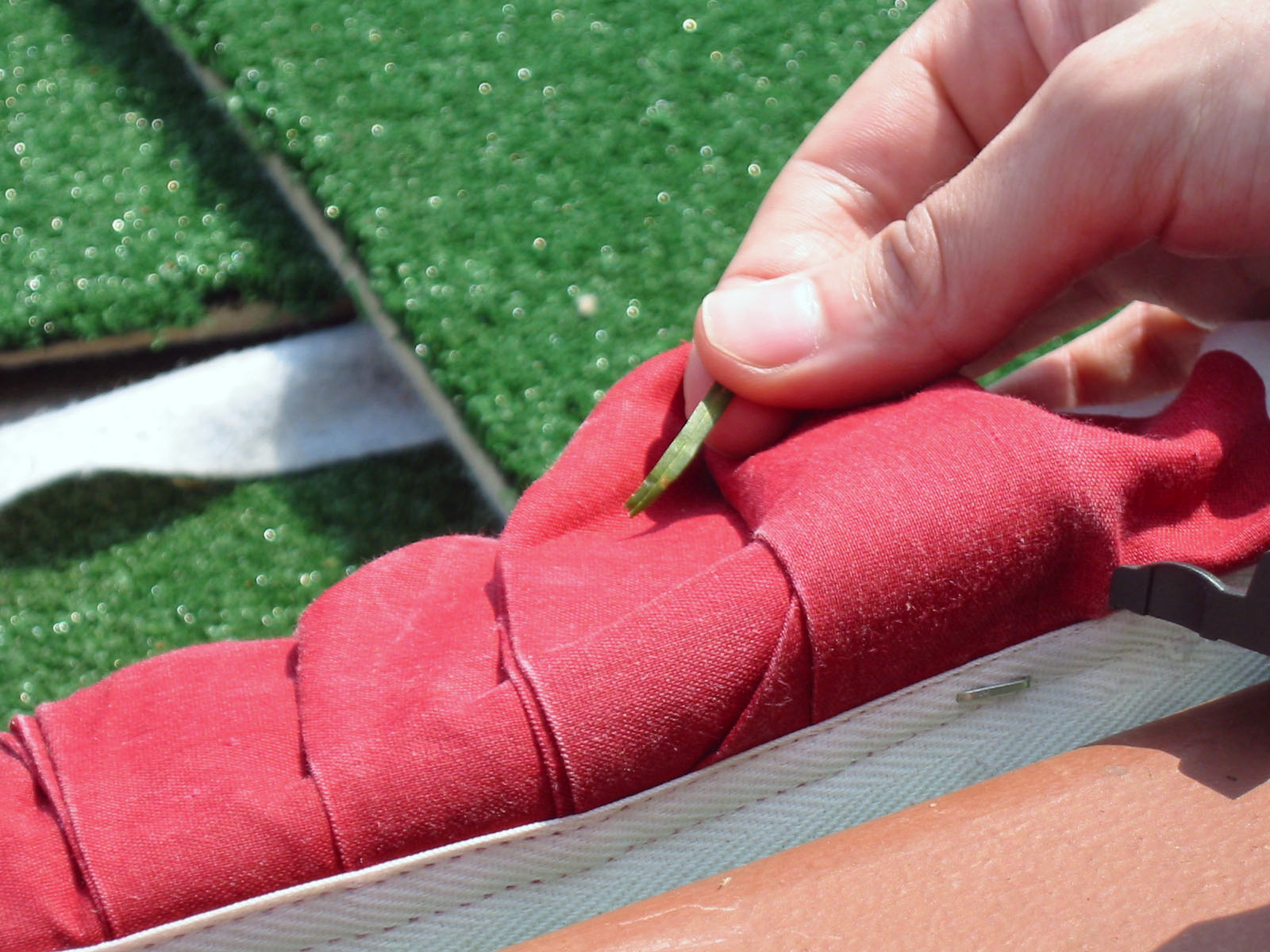
Turf
Still Life with Blade of Grass, Bunting, Staple, Artificial Turf, and Hand
(Wait, only two of those things are alive.)

Johjima
Kenji Johjima, the first Japanese league catcher to play in the MLB.

Dr. Steinberg
The Red Sox chief of flack, Dr. Charles Steinberg.

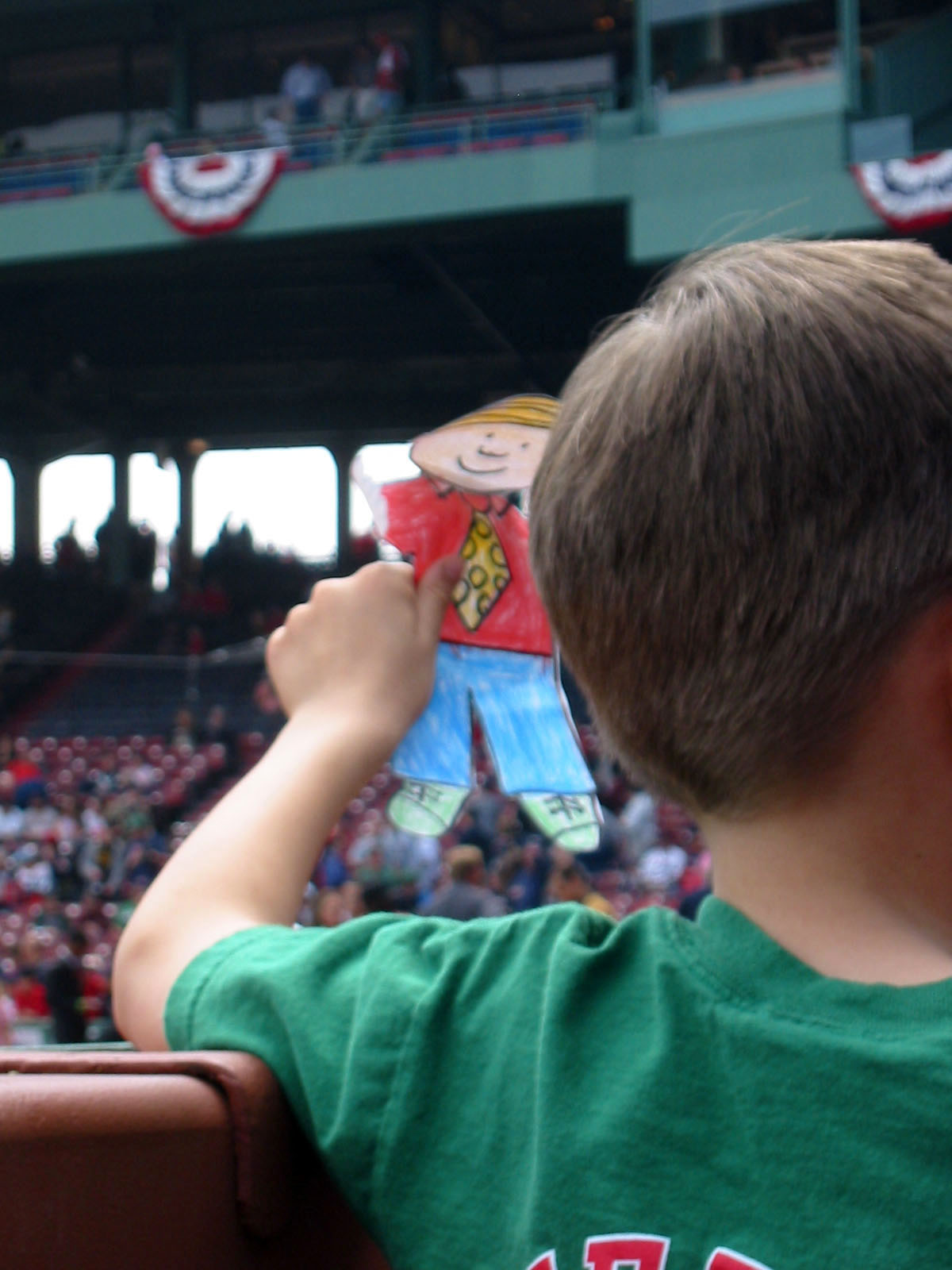
Paper Man
This little boy and his dad were laboring to get this paper cut-out in the foreground of a shot of Fenway.

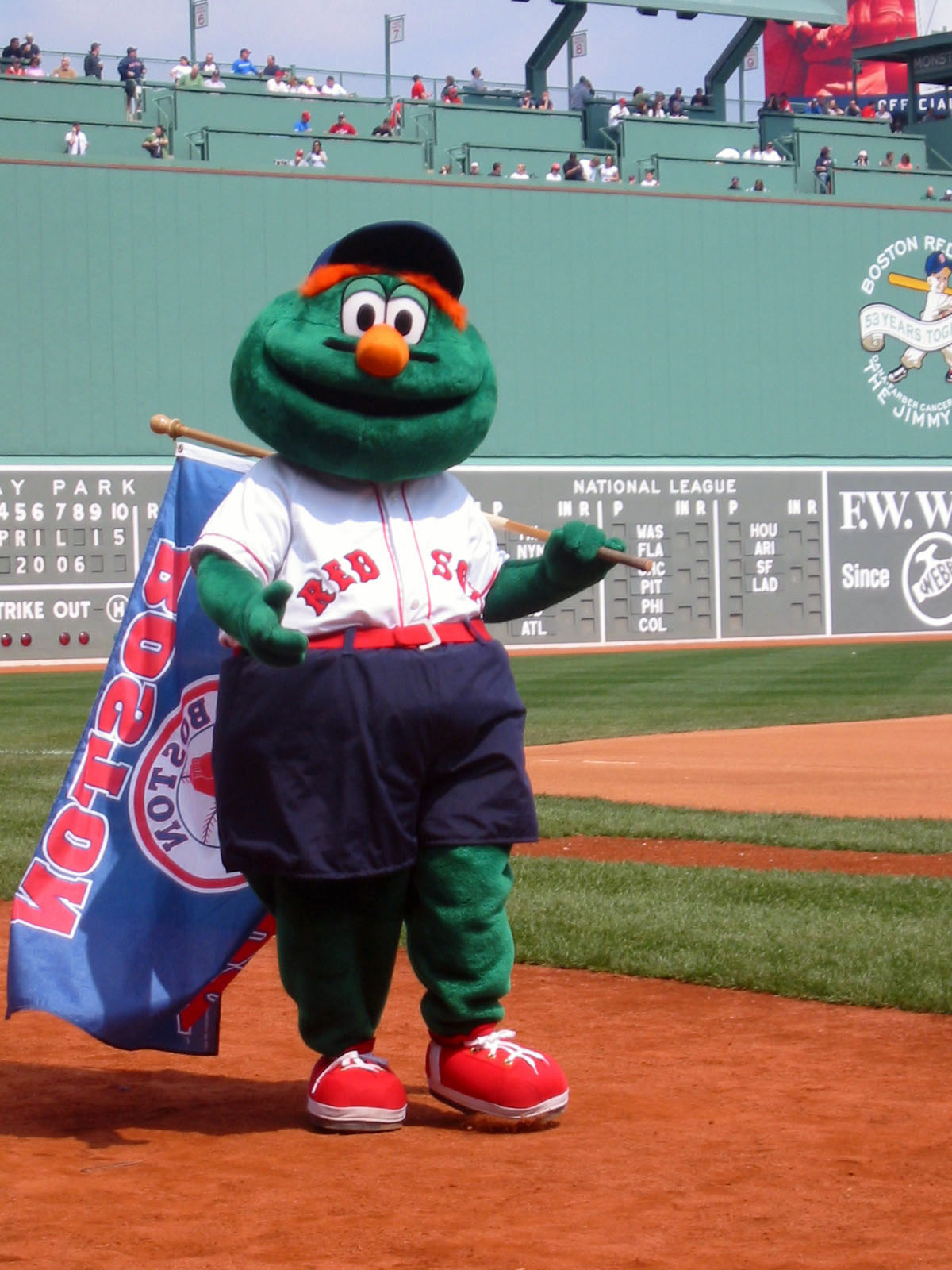
New Look Wally
Now Wally’s waist is as big as his heart.

Blades
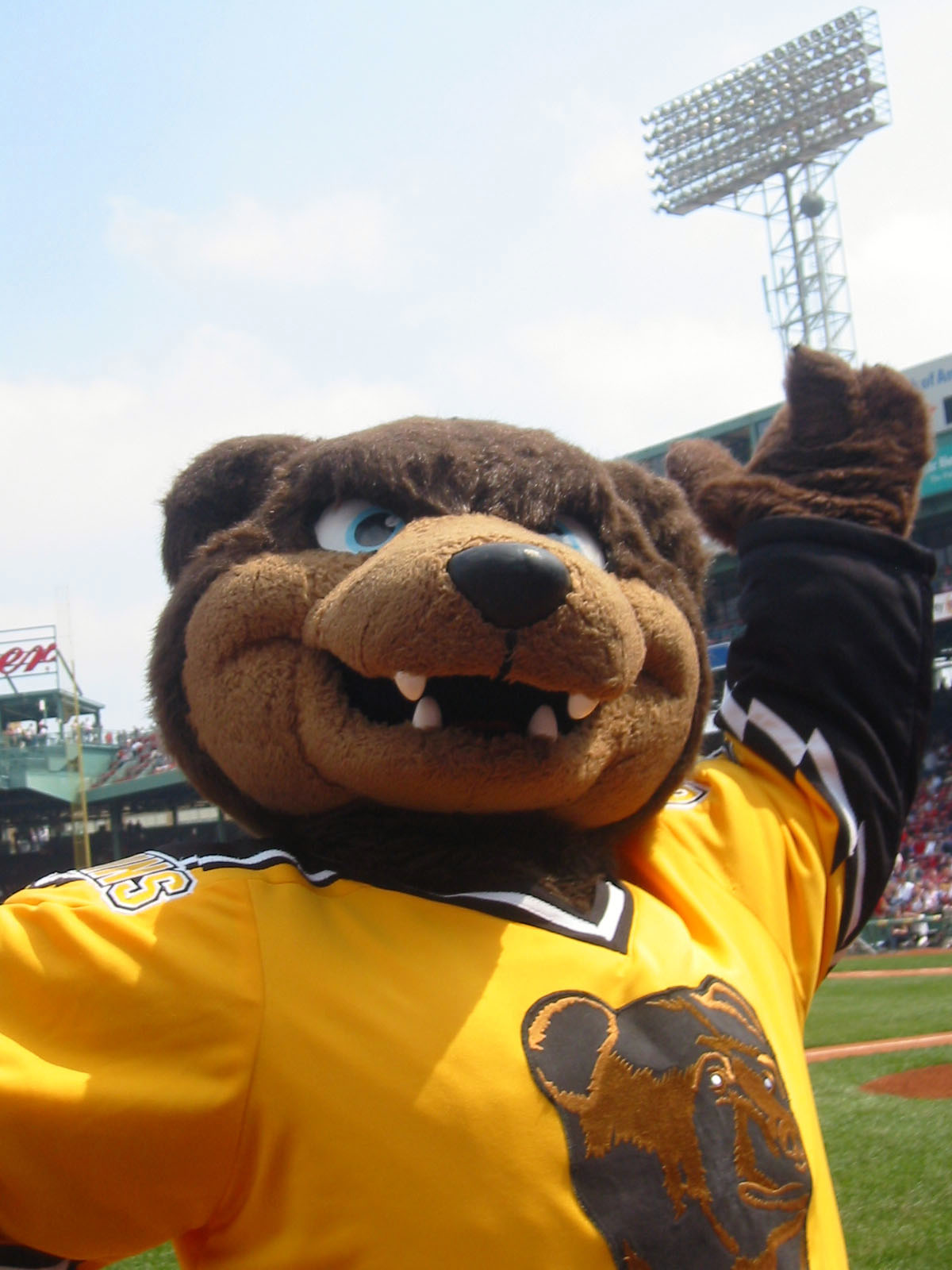
Blade may look like a bear, but he’s really a camera hog.

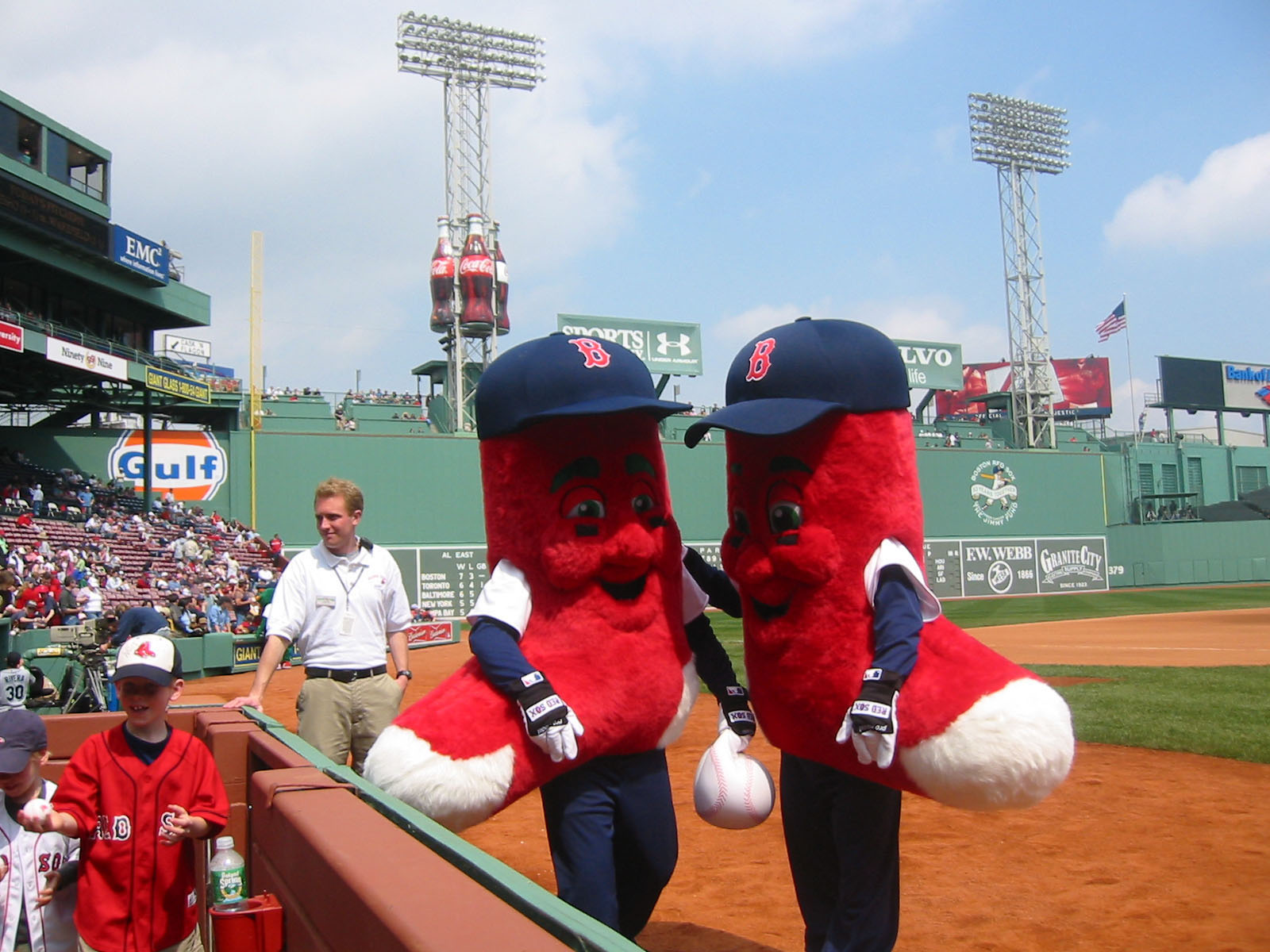
Lefty & Righty
Sock it to us?

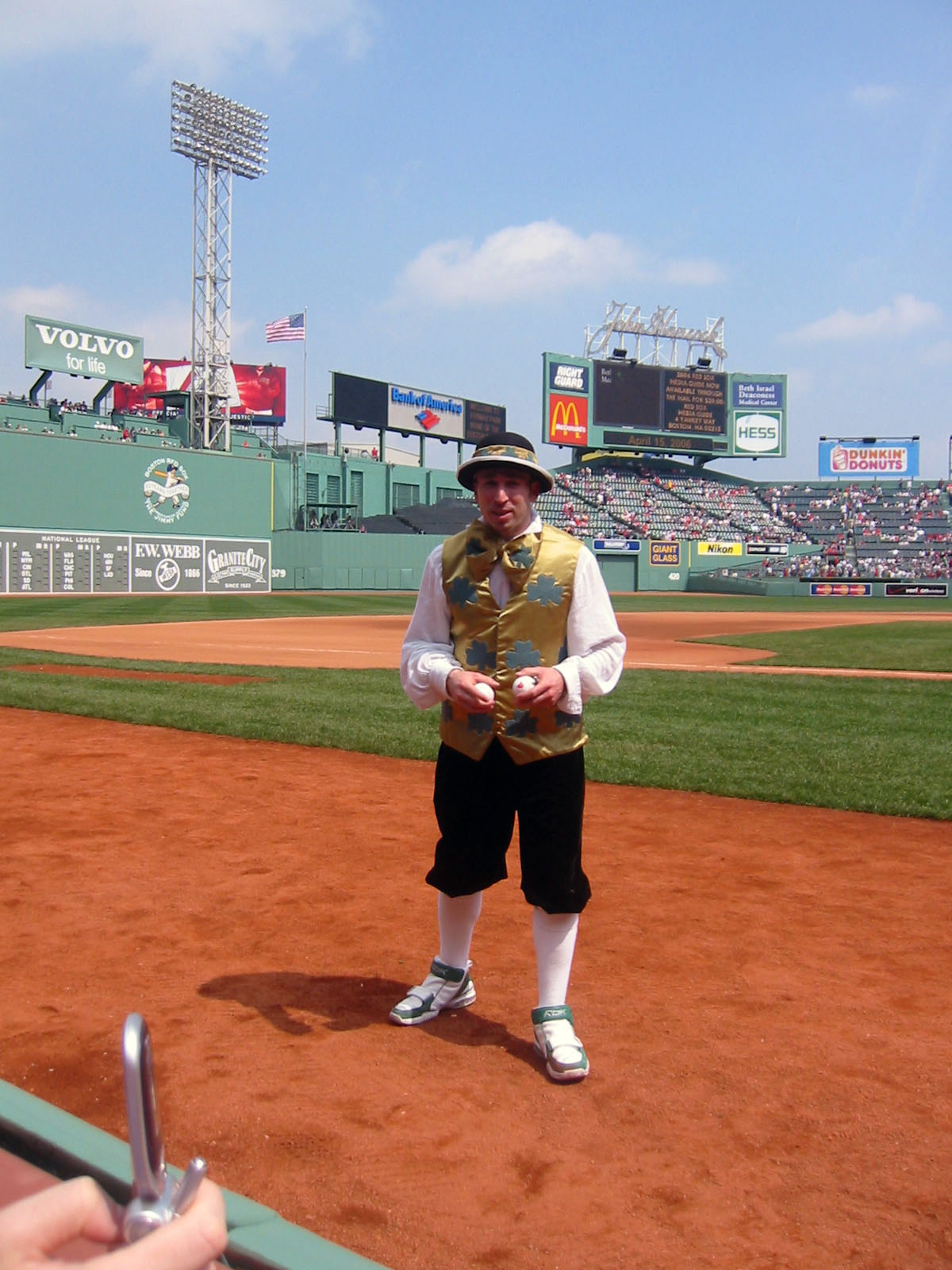
Lucky
One hint: he’s not named that because of his way with the ladies.

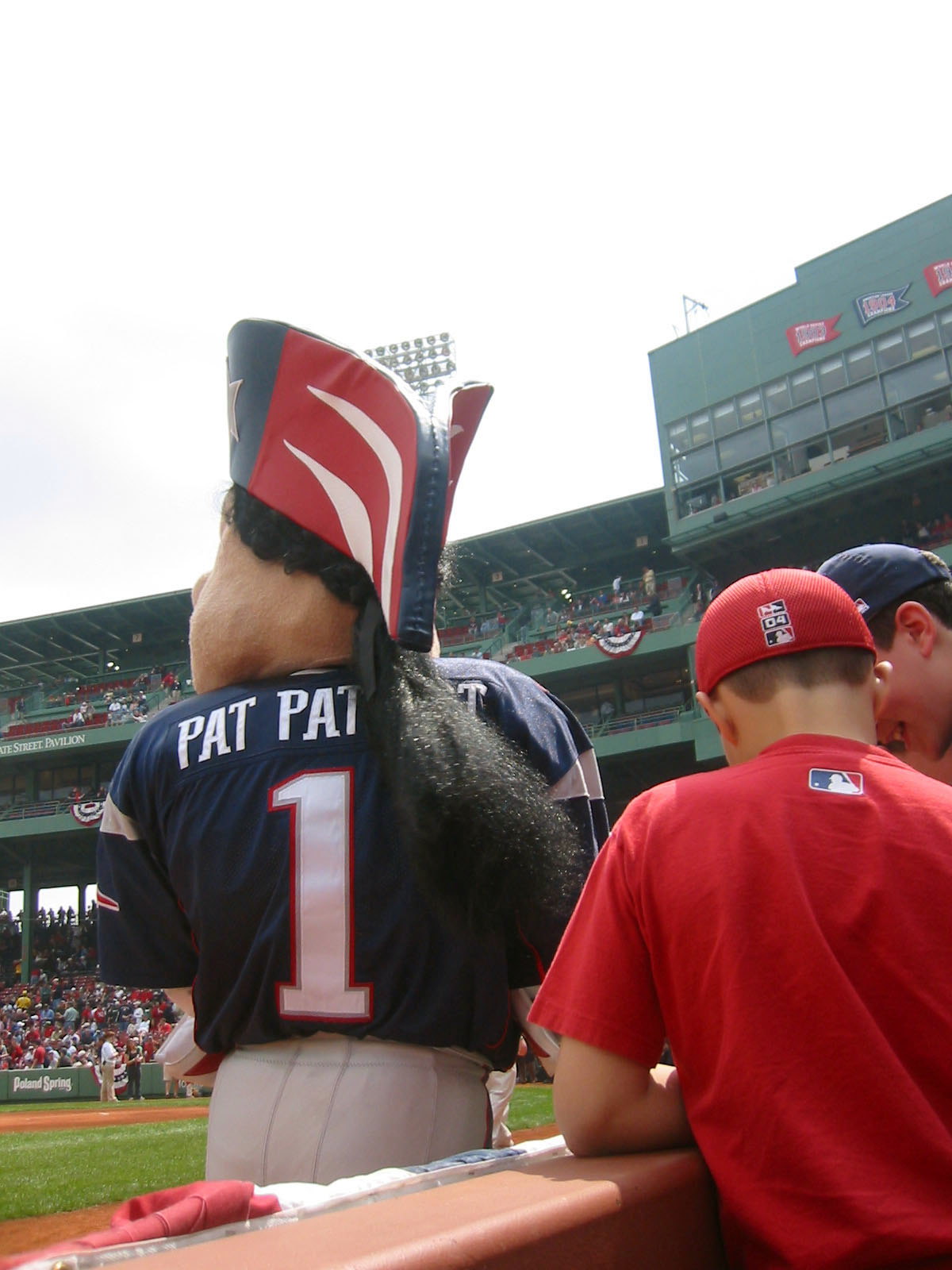
Pat
Pat was a bit aloof. I guess that’s what happens when you win three world championships.

Mascots Galore
Who will be voted off on this episode of “American Idol: Mascot Edition”?

Jackie Robinson Day
“The right of every American to first-class citizenship is the most important issue of our time.”

Wells
David Wells demonstrates his only foolproof method to keep his ERA down.

Asleep

Game 11: April 15, 2006
Mariners (6-6), 3
Red Sox (7-4), 0
W: Joel Pineiro (2-1)
H: J.J. Putz (2)
S: Eddie Guardado (2)
L: Tim Wakefield (1-2)

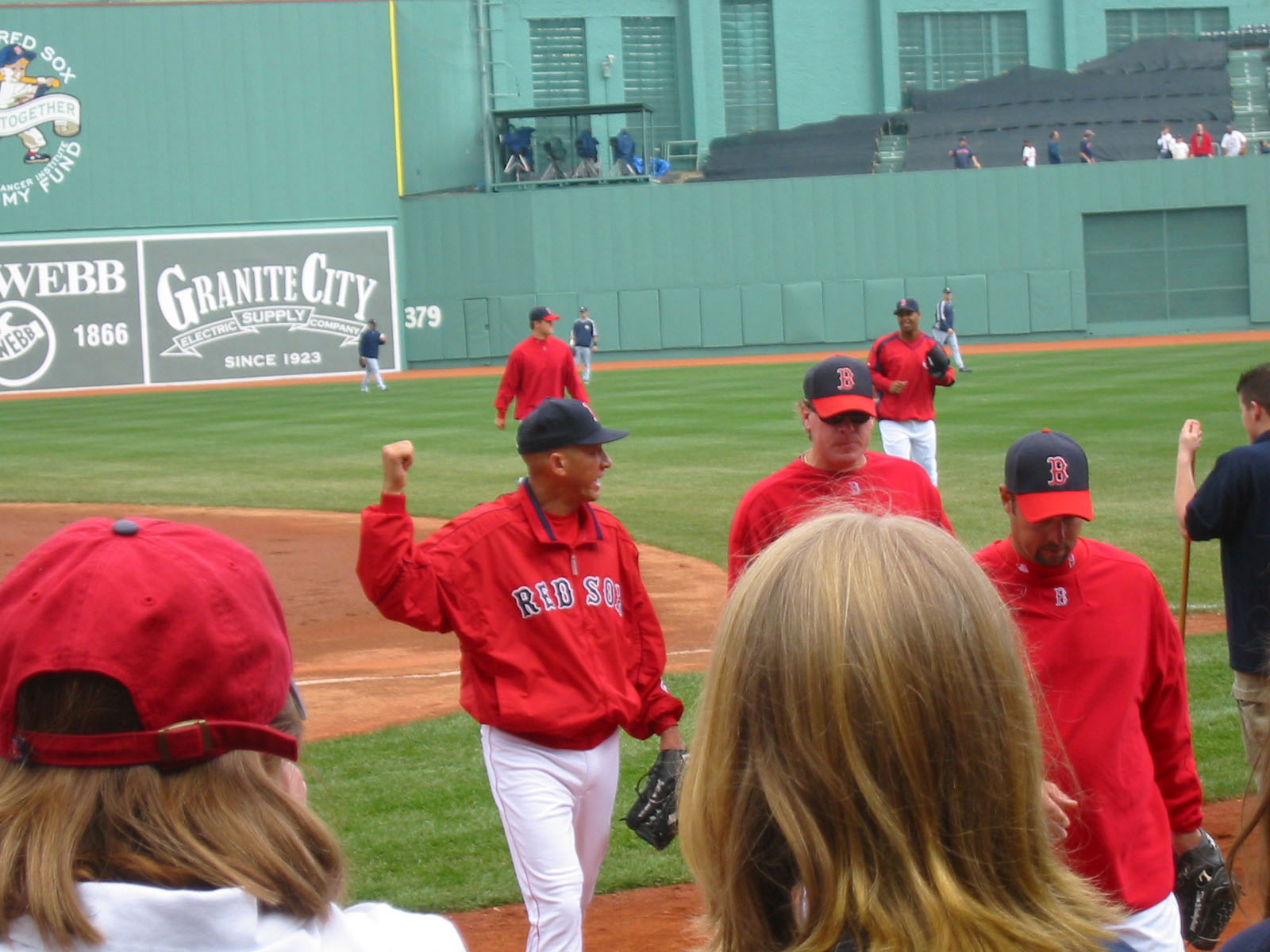
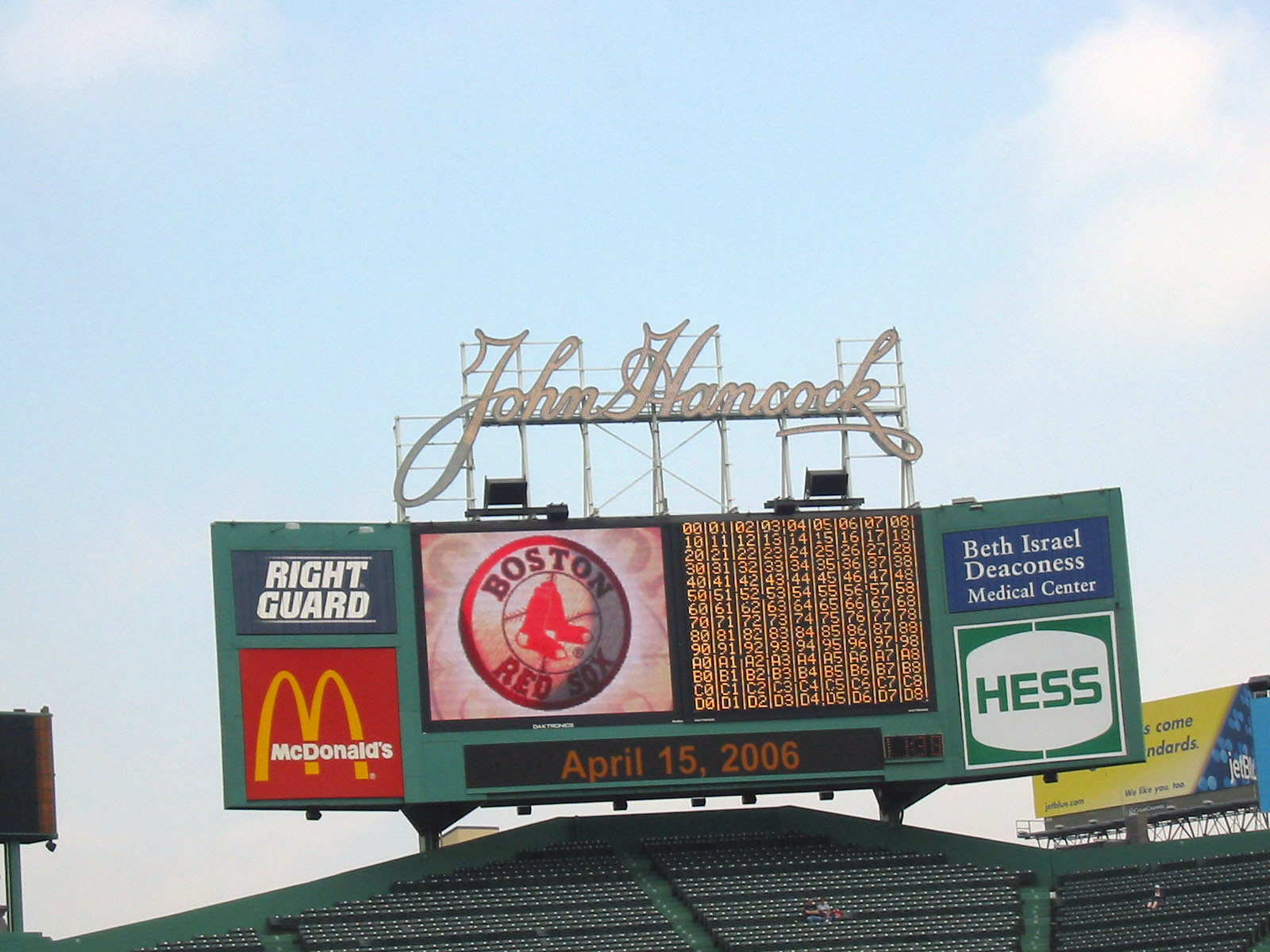
Thanks to Jere at A Red Sox Fan in Pinstripe Territory, I got to attend yesterday’s game. Unfortunately, it was because his usual accomplice got into a car accident (he’s fine) and the second in line was volunteering for charitable organization. Terry Francona was equally and simultaneously disastrous and philanthropic judging by the lineup he contrived:

  1. Adam Stern, CF
  2. Alex Cora, 2B
  3. David Ortiz, DH
  4. Manny Ramirez, LF
  5. Kevin Youkilis, 3B
  6. J.T. Snow, 1B
  7. Wily Mo Peña, RF
  8. Josh Bard, C
  9. Alex Gonzalez, SS

Given the above, is it any surprise the Red Sox were shut out for the first time this season? Joel Pineiro ably took on Ted Lilly’s mantle, pitching six and a third innings with just five hits, two walks, and five strikeouts.

I thought Francona could use some helpful hints; here are my rules for constructing Red Sox lineups:

  1. No more than one “Alex” permitted in a day.
  2. You must have at least one infielder whose surname begins with “Lo” start at all times.
  3. When the “Bard” sings, the “Snow” must not fall.

I can’t imagine what Tim Wakefield must have thought when he saw the lineup card. He busted his hump for a complete game loss, throwing 108 pitches for nine hits, three runs (two earned), and six strikeouts. I understand the difference between playing time for hitters and pitchers and that the bullpen is stretched thin after David Wells and Matt Clement’s back-to-back disappointing starts, but it still seems slightly contradictory of Francona to let the 39-year old pitcher take one for the team while the productive members of the offense sit.

At least my seating companions were enjoyable. Jere and I swung by Section 12 to see if Andrew of 12eight was there, and indeed he was, with this father. In another stroke of happenstance, two seats near them were vacant and we got to sit with them. There was much discussion of uniform numbers, baseball trivia (such as longest-running plate appearance reaching first base streaks), and Red Sox players of the past.

Perhaps at the next game I attend should be with a baseball neophyte who continually asks questions thereby distracting me from the game. I’m sure then Clement would throw a perfect game, Gonzalez would turn an unassisted triple play, and Ortiz would hit for the cycle in natural order.

Pictures of the day’s festivities to follow.

Rubber Match

Here at last are some pictures from Thursday, April 13th.

Join Crisp
Get well soon, Coco.

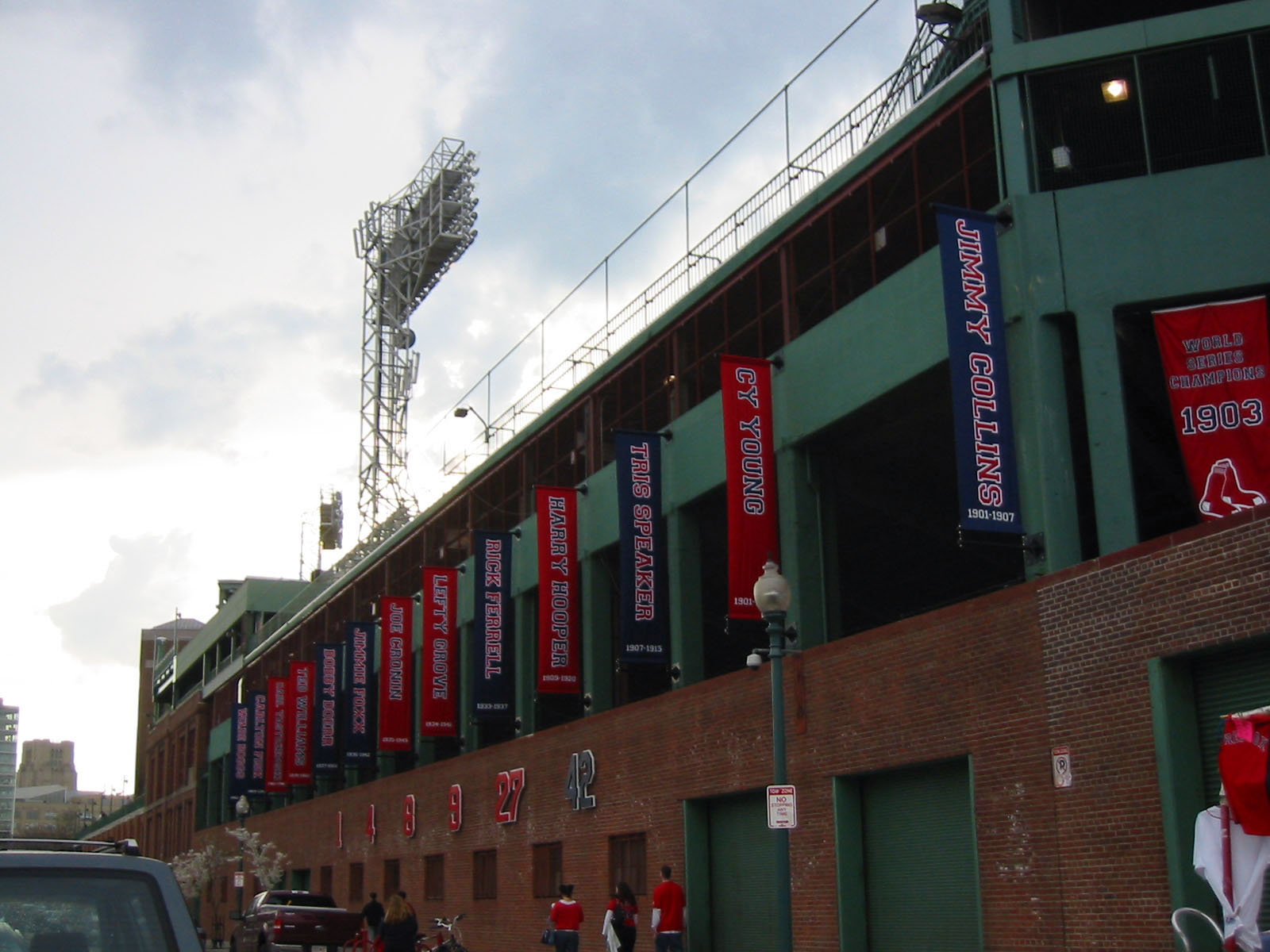
Hall of Fame banners
It’s difficult to discern the criteria, if any, there are to have a banner on Van Ness. Tris Speaker is included even though he wears a Cleveland Indians cap on his plaque. Similarly, Cy Young wears a Cleveland Naps cap. Harry Hooper does not have an insignia and Jimmy Collins does not wear a hat.

Ortiz H2
The David Ortiz Signature H2. I’m certain it is well-appointed with the finest mango salsa.

New Wall Logo
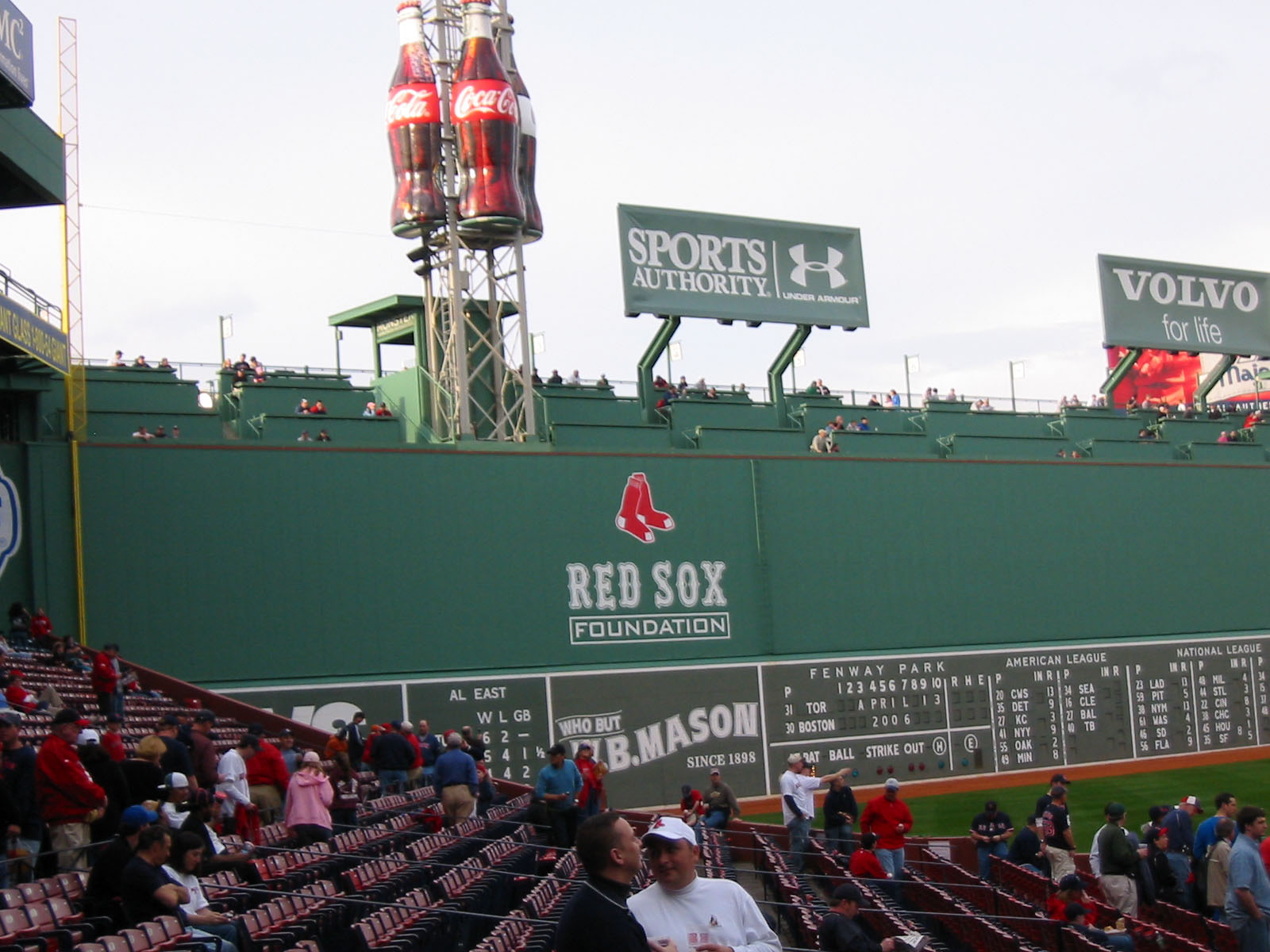
The Monster is newly emblazoned with the logo of the Red Sox’s charitable foundation. The labels on the Coke bottles have also been switched out; instead of vanilla, there are two classic Cokes and a Coca-Cola Zero.

Observant Wally
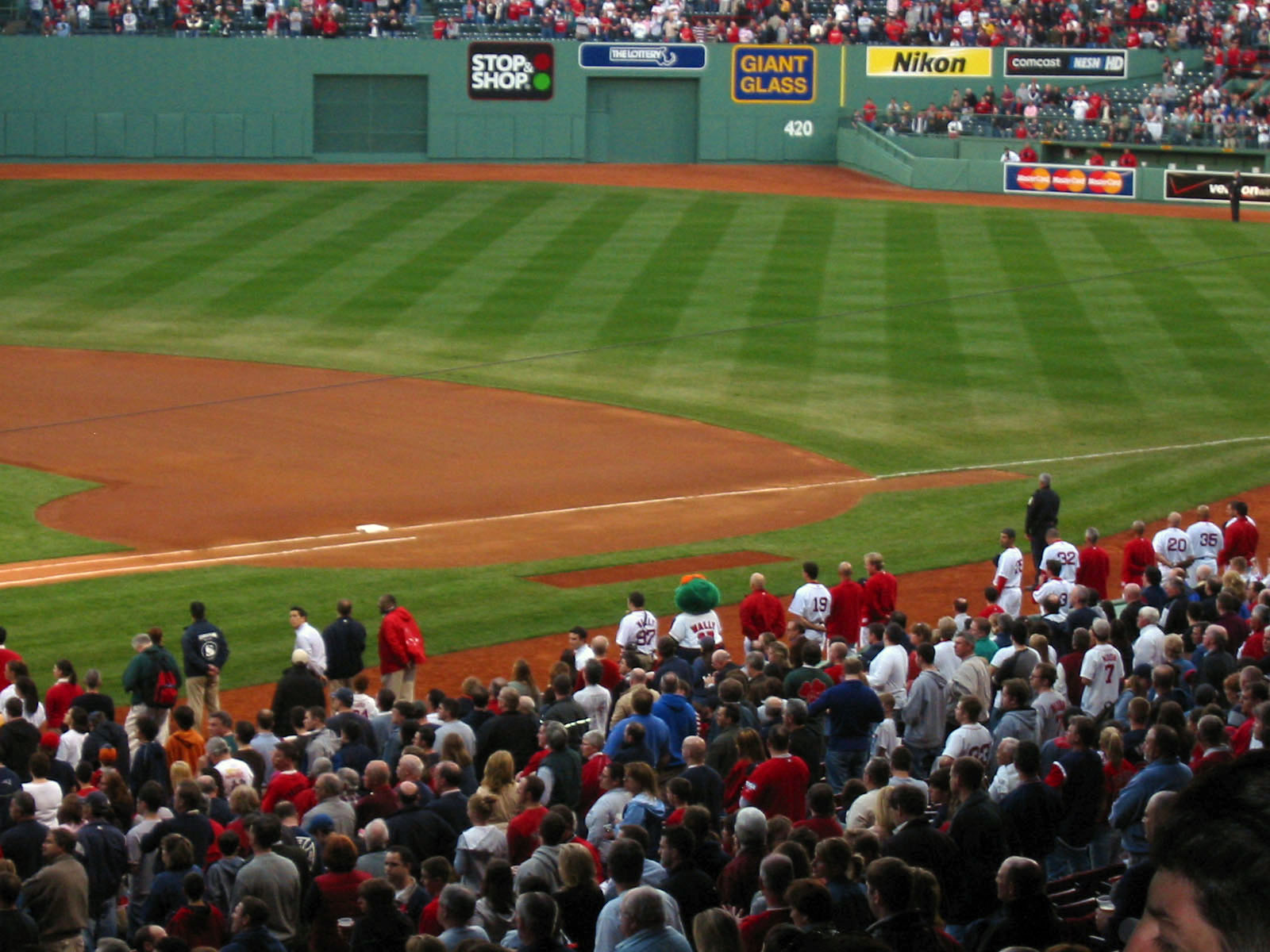
Even the mascot is on board with the new, more professional demeanor of the team. Wally now removes his hat during the anthem.

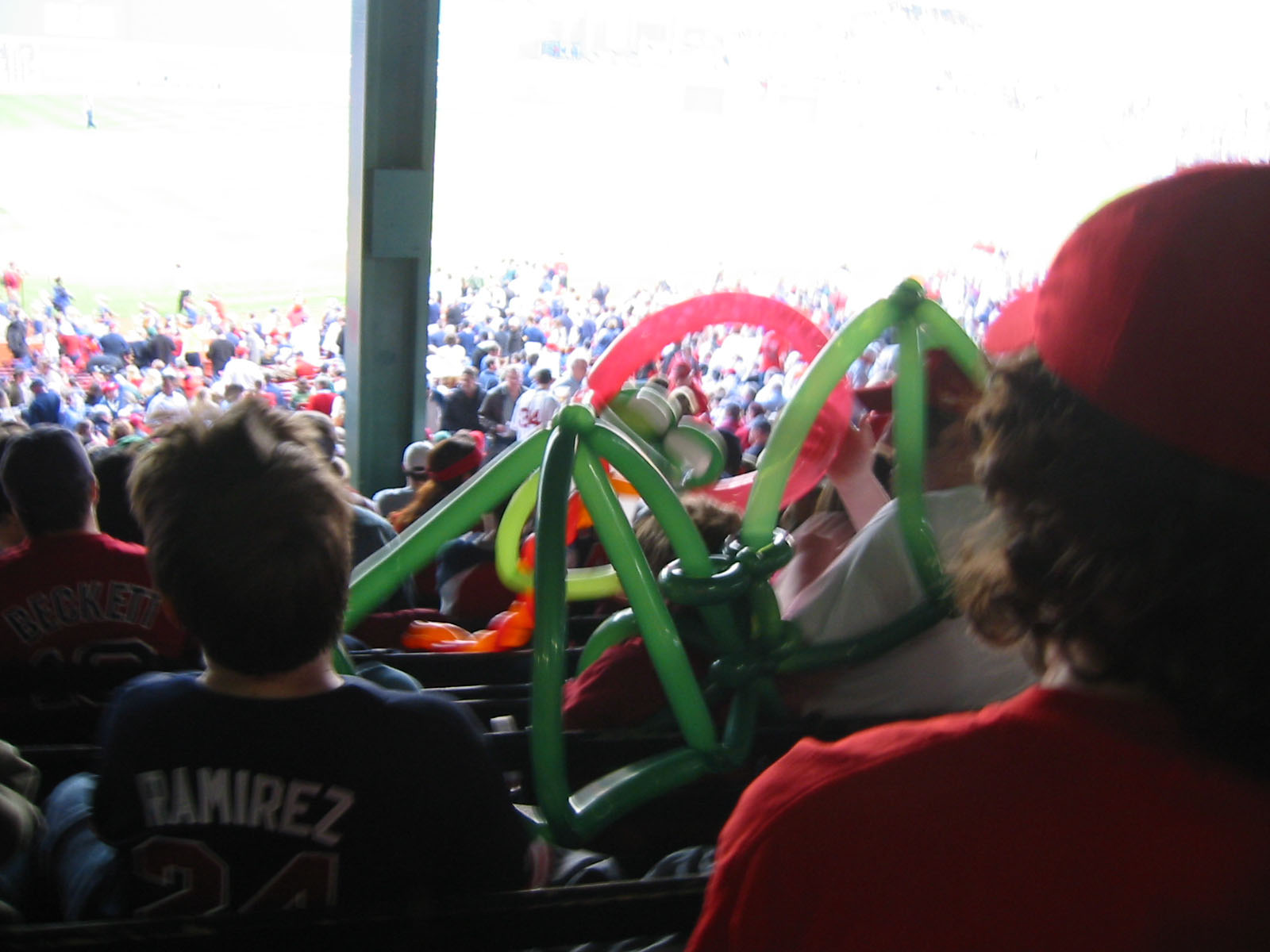
Balloon Dragon
Balloon mythical creatures: good on Yawkey Way, bad in the grandstand. The father eventually convinced his son to give up the dragon.

CFB Matt
Mojo Matt of NU50 is a total casual fan.

April 14, 2006

Dave’s Diegesis: Transfusion Confusion

Genius is always allowed some leeway, once the hammer has been pried from its hands and the blood has been cleaned up.
Terry Pratchett

Blood is thicker than water and you can’t get it from a stone. Baseball is back, and it gets my heart beating and my blood pumping. Like Johnny Pesky, the Red Sox are in my blood.

Even before William Harvey correctly described the circulatory system in 1628, blood was the centerpiece of a myriad of powerful beliefs. The word “blessing” originates from the Old English “blœdsian,” which described a certain act sacred to Germanic migrants to Britain, the Angles, Saxons, and Jutes. These tribes believed that dismembering their adversaries and sprinkling their blood on consecrated objects, places, and themselves and would grant them the strength of the enemies.

Beyond the myths of blood, however, is the intricate study of blood, or hematology. Most people know about blood types, but few know why transfusions between incorrect types can be fatal. The ABO system of blood typing classifies human blood according to the antigens that characterize the immune response of red blood cells:

  • Group A, whose red blood cells’ surfaces are covered with antigen A. The immune system will produce antibodies against cells that have antigen B. They can only receive blood from other type As or O.
  • Group B is the opposite of group A.
  • Group AB has both A and B antigens. Preferably they would receive AB, but A, B, or O may also be transfused.
  • Group O has neither A or B antigens, so all other types can accept type O blood, making this type the universal donor type. It does produce antibodies to counteract A and B antigens, so type O can only accept type O blood.

In addition to the letter types above, there is also the Rhesus factor, or Rh factor, named after the Rhesus monkey. A positive or negative sign indicate the presence or absence of this antigen. The mistyping of Rh factor is particularly perilous to women who, if they receive the incorrect blood type, may develop antibodies that could impact a fetus. The antibodies could traverse the placenta and attack the red blood cells of the developing child in a process called hemolysis. Hemolysis renders red blood cells useless, ravaging the cell membrane and releasing oxygen-carrying hemoglobin into the blood plasma.

It’s odd how science can flow back into folklore. In Japan, blood types are supposed to be indicative of personality, much like astrological signs, numerology, or other forms of quackery. Other places in Asia are beginning to subscribe to this system and asking someone their blood type there is as common as asking what one’s sign is.

Not that I believe in the theory of blood type personalities, but here’s what I think certain Red Sox players, past and present, would be. The traits are derived from Wikipedia and the otaku site called Issendai’s Lair.

  • A: Conservative, reserved, patient, punctual, perfectionist, good with plants, introverted, obsessive, stubborn, self-conscious, and uptight.
    Well, Curt Schilling is a lot of the above except for being reserved and introverted. I’ve heard tell that Mark Bellhorn was good with plants. Nomar Garciaparra had a streak of shyness and compulsion. Like the “Type A” personality that used to be associated with coronary heart disease by American cardiologist Meyer Friedman (another personality type system that has been debunked), they are stressed and goal-driven.
  • B: Creative, passionate, animal loving, optimistic, flexible, forgetful, irresponsible, and individualistic.
    Pedro Martinez, anyone? Although I’m not too sure how keen he was on pets. Type Bs are portrayed as unconventional, off-the-wall, and ruled by their impulses.
  • AB: Cool, controlled, rational, sociable, popular, empathic, aloof, critical, indecisive, and unforgiving.
    Keith Foulke strikes me as an AB, with his calm, nearly impassive, demeanor. He still seems to be stung by the fans revolting against him last year. In anime, villains are often type AB.
  • O: Ambitious, athletic, robust, self-confident, natural leader, arrogant, vain, insensitive, and ruthless.
    Who else but David Ortiz? There might be a budding Little Papi in Jonathan Papelbon. Type O is considered the best type according to Japanese standards of behavior.

Every Friday, Dave McCarty will join us to discuss a topic of interest to him and probably no one else but the author of this site.

Scintillating

Game 10: April 14, 2006
Mariners (5-6), 1
Red Sox (7-3), 2
L: Jamie Moyer (0-2)
W: Curt Schilling (3-0)
S: Jonathan Papelbon (5)

Things are looking good for a pitcher when you are able to strike out Ichiro Suzuki twice in a game and hold him hitless, even with the right fielder’s sluggish start. Curt Schilling only allowed three hits and one earned run over seven innings while striking out seven. Currently, Schilling has the lowest WHIP of all active starting pitchers with 0.64. Mark Hendrickson of the Royals and Noah Lowry of the Giants both have lower rates at 0.44 and 0.60 respectively, but are on the disabled list.

Another Red Sox pitcher is in the top 10 of WHIP for relief pitchers with a minuscule 0.33. Jonathan Papelbon pitched a near-perfect ninth inning, surrendering only a single line drive off the wall by Jose Lopez. In Papelbon’s six innings of work so far this season, he has hurled 76 pitches with 53 of those being strikes, or a 70% strike rate.

In the top of the seventh, Wily Mo Peña made a catch very similar to the one he muffed on June 13th when he was on the Reds. He took his route towards the bend in right field and caught Adrian Beltre’s fly ball on the run.

Of all hitters the Red Sox can rely on, Alex Gonzalez is the one you’d least expect to have a three for four evening and, in a stacked lineup, the only one to drive in runs. He doubled of the wall to score Mike Lowell and Dustan Mohr. Thanks to Gonzalez’s power surge, Boston is now 3-0 in in one-run games.

Carl Everett drove in the Mariners’ only run in the fifth inning when he grounded out to Lowell. The Red Sox third baseman briefly considered attempt to gun out Richie Sexson, who had reached on a leadoff double. Instead, Lowell propelled the ball to third for the second out of the inning. Booing at Everett’s at bats has become perfunctory and no real malice accompanies the cat calls. It’s akin to blessing nearby people who sneeze; a habit rather than an act rife with intent.